


Page 207 - CyberSecurityEssentialsEnglish
P. 207
checking  kills  productivity,  and  weak  checking  lets  errors  through  [9].  Published  risk
         management guidance makes the same point in different words: controls should match the
         level of risk rather than being applied uniformly [10].


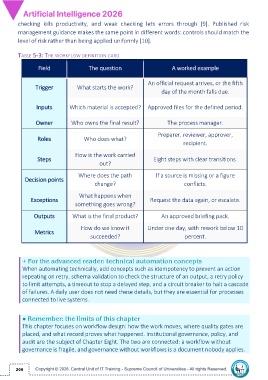
         TABLE 5-3: THE WORKFLOW DEFINITION CARD


                  Field                 The question                         A worked example


                                                                   An official request arrives, or the fifth
                 Trigger           What starts the work?
                                                                         day of the month falls due.


                 Inputs         Which material is accepted?  Approved files for the defined period.


                 Owner           Who owns the final result?                The process manager.

                                                                       Preparer, reviewer, approver,
                  Roles               Who does what?
                                                                                  recipient.

                                  How is the work carried
                  Steps                                              Eight steps with clear transitions.
                                             out?


                                    Where does the path               If a source is missing or a figure
            Decision points
                                           change?                                 conflicts.

                                    What happens when
               Exceptions                                           Request the data again, or escalate.
                                  something goes wrong?

                Outputs          What is the final product?              An approved briefing pack.

                                     How do we know it             Under one day, with rework below 10
                Metrics
                                         succeeded?                                percent.


           + For the advanced reader: technical automation concepts

           When automating technically, add concepts such as idempotency to prevent an action
           repeating on retry, schema validation to check the structure of an output, a retry policy
           to limit attempts, a timeout to stop a delayed step, and a circuit breaker to halt a cascade
           of failures. A daily user does not need these details, but they are essential for processes
           connected to live systems.


           ● Remember: the limits of this chapter

           This chapter focuses on workflow design: how the work moves, where quality gates are
           placed, and what record proves what happened. Institutional governance, policy, and
           audit are the subject of Chapter Eight. The two are connected: a workflow without
           governance is fragile, and governance without workflows is a document nobody applies.


        206

