


Page 203 - CyberSecurityEssentialsEnglish
P. 203
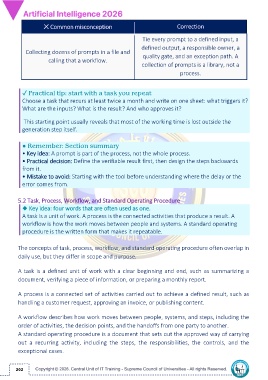
✕ Common misconception                                      Correction

                                                                Tie every prompt to a defined input, a
                                                                defined output, a responsible owner, a
            Collecting dozens of prompts in a file and
                                                                quality gate, and an exception path. A
                       calling that a workflow.
                                                                collection of prompts is a library, not a

                                                                                 process.


           ✓ Practical tip: start with a task you repeat
           Choose a task that recurs at least twice a month and write on one sheet: what triggers it?
           What are the inputs? What is the result? And who approves it?


            This starting point usually reveals that most of the working time is lost outside the
           generation step itself.

           ● Remember: Section summary

           • Key idea: A prompt is part of the process, not the whole process.
           • Practical decision: Define the verifiable result first, then design the steps backwards
           from it.
           • Mistake to avoid: Starting with the tool before understanding where the delay or the
           error comes from.


         5.2 Task, Process, Workflow, and Standard Operating Procedure
           ◆ Key idea: four words that are often used as one.
           A task is a unit of work. A process is the connected activities that produce a result. A
           workflow is how the work moves between people and systems. A standard operating
           procedure is the written form that makes it repeatable.


         The concepts of task, process, workflow, and standard operating procedure often overlap in
         daily use, but they differ in scope and purpose.

         A task is a defined unit of work with a clear beginning and end, such as summarizing a

         document, verifying a piece of information, or preparing a monthly report.

         A process is a connected set of activities carried out to achieve a defined result, such as
         handling a customer request, approving an invoice, or publishing content.

         A workflow describes how work moves between people, systems, and steps, including the
         order of activities, the decision points, and the handoffs from one party to another.

         A standard operating procedure is a document that sets out the approved way of carrying
         out  a  recurring  activity,  including  the  steps,  the  responsibilities,  the  controls,  and  the
         exceptional cases.


        202

