


Page 204 - CyberSecurityEssentialsEnglish
P. 204
A process may exist in practice even if it has never been documented. Staff know that a
         request arrives, is reviewed, and is then sent elsewhere, but each person may carry out the
         steps differently. The first step is therefore to discover the as-is process as it is actually

         performed, not as it is assumed to be performed.

         The current process can be understood through interviews, observation, and system logs.
         Where structured event logs are available, process mining can be used to reveal the actual

         path of the work, the waiting times, the repetitions, and the deviations from the expected
         procedure [7][8].

         After understanding the reality, the to-be process is designed. It should not be merely a
         digital  copy  of  the  current  steps,  because  some  of  those  steps  may  reflect  an  earlier

         weakness,  such  as  re-entering  data  that  already  exists,  sending  a  file  to  several  people
         because permissions were unclear, or repeating reviews that add no real value. Analysis and,
         where needed, redesign therefore precede automation.


         Business Process Model and Notation provides a standard way of representing processes

         visually using events, tasks, decision gateways, flows, and roles [1][2]. Its purpose is not to
         produce an elegant diagram, but to make clear how work moves, who decides, where delays
         occur, how exceptional cases are handled, and which steps can be improved or automated.


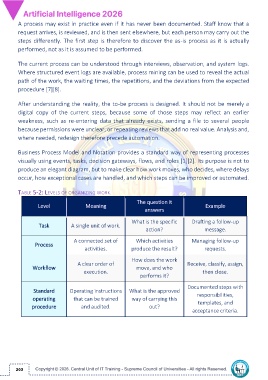
         TABLE 5-2: LEVELS OF ORGANIZING WORK

                                                              The question it
                  Level                Meaning                                              Example
                                                                 answers


                                                            What is the specific      Drafting a follow-up
                  Task           A single unit of work.
                                                                  action?                   message.

                                  A connected set of         Which activities         Managing follow-up
                 Process
                                       activities.         produce the result?              requests.

                                                            How does the work
                                    A clear order of                                Receive, classify, assign,
                Workflow                                      move, and who
                                      execution.                                           then close.
                                                               performs it?

                                                                                    Documented steps with
                Standard        Operating instructions  What is the approved
                                                                                         responsibilities,
                operating         that can be trained       way of carrying this
                                                                                         templates, and
               procedure             and audited.                  out?
                                                                                      acceptance criteria.


        203

