


Page 210 - CyberSecurityEssentialsEnglish
P. 210
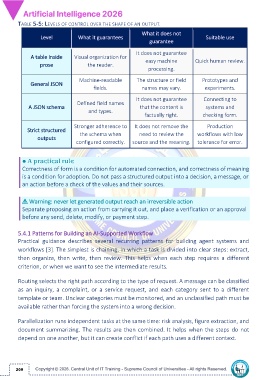
TABLE 5-5: LEVELS OF CONTROL OVER THE SHAPE OF AN OUTPUT
                                                                What it does not
                   Level            What it guarantees                                       Suitable use
                                                                   guarantee

                                                              It does not guarantee
               A table inside     Visual organization for
                                                                  easy machine          Quick human review.
                   prose                the reader.
                                                                   processing.


                                    Machine-readable          The structure or field       Prototypes and
               General JSON
                                           fields.              names may vary.             experiments.

                                                              It does not guarantee         Connecting to
                                   Defined field names
              A JSON schema                                    that the content is          systems and
                                        and types.
                                                                 factually right.          checking form.

                                  Stronger adherence to      It does not remove the          Production
             Strict structured
                                     the schema when           need to review the        workflows with low
                  outputs
                                   configured correctly.    source and the meaning.  tolerance for error.


           ● A practical rule
           Correctness of form is a condition for automated connection, and correctness of meaning
           is a condition for adoption. Do not pass a structured output into a decision, a message, or
           an action before a check of the values and their sources.


           ⚠ Warning: never let generated output reach an irreversible action
           Separate proposing an action from carrying it out, and place a verification or an approval
           before any send, delete, modify, or payment step.


         5.4.1 Patterns for Building an AI-Supported Workflow
         Practical  guidance  describes  several  recurring  patterns  for  building  agent  systems  and
         workflows [3]. The simplest is chaining, in which a task is divided into clear steps: extract,

         then  organize,  then  write,  then  review.  This  helps  when  each  step  requires  a  different
         criterion, or when we want to see the intermediate results.

         Routing selects the right path according to the type of request. A message can be classified
         as  an  inquiry,  a  complaint,  or  a  service  request,  and  each  category  sent  to  a  different

         template or team. Unclear categories must be monitored, and an unclassified path must be
         available rather than forcing the system into a wrong decision.

         Parallelization runs independent tasks at the same time: risk analysis, figure extraction, and
         document summarizing. The results are then combined. It helps when the steps do not

         depend on one another, but it can create conflict if each path uses a different context.


        209

