


Page 212 - CyberSecurityEssentialsEnglish
P. 212
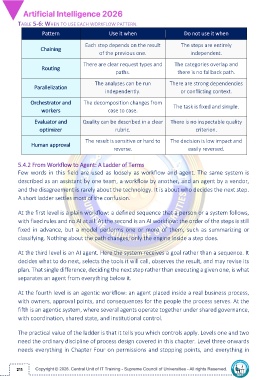
TABLE 5-6: WHEN TO USE EACH WORKFLOW PATTERN
                    Pattern                      Use it when                       Do not use it when


                                       Each step depends on the result           The steps are entirely
                   Chaining
                                             of the previous one.                     independent.

                                      There are clear request types and        The categories overlap and
                    Routing
                                                    paths.                      there is no fallback path.

                                           The analyses can be run          There are strong dependencies
                Parallelization
                                                independently.                   or conflicting context.

               Orchestrator and       The decomposition changes from
                                                                              The task is fixed and simple.
                   workers                       case to case.

                Evaluator and         Quality can be described in a clear    There is no inspectable quality
                   optimizer                        rubric.                             criterion.

                                       The result is sensitive or hard to    The decision is low impact and
               Human approval
                                                   reverse.                          easily reversed.


         5.4.2 From Workflow to Agent: A Ladder of Terms
         Few words in this field are used as loosely as workflow and agent. The same system is
         described as an assistant by one team, a workflow by another, and an agent by a vendor,

         and the disagreement is rarely about the technology. It is about who decides the next step.
         A short ladder settles most of the confusion.

         At the first level is a plain workflow: a defined sequence that a person or a system follows,
         with fixed rules and no AI at all. At the second is an AI workflow: the order of the steps is still

         fixed  in  advance,  but  a  model  performs one  or  more  of  them,  such  as  summarizing  or
         classifying. Nothing about the path changes; only the engine inside a step does.

         At the third level is an AI agent. Here the system receives a goal rather than a sequence. It

         decides what to do next, selects the tools it will call, observes the result, and may revise its
         plan. That single difference, deciding the next step rather than executing a given one, is what
         separates an agent from everything below it.

         At the fourth level is an agentic workflow: an agent placed inside a real business process,

         with owners, approval points, and consequences for the people the process serves. At the
         fifth is an agentic system, where several agents operate together under shared governance,
         with coordination, shared state, and institutional control.


         The practical value of the ladder is that it tells you which controls apply. Levels one and two

         need the ordinary discipline of process design covered in this chapter. Level three onwards
         needs everything in Chapter Four on permissions and stopping points, and everything in


        211

