


Page 290 - CyberSecurityEssentialsEnglish
P. 290
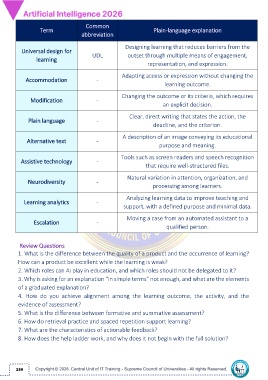
Common
                   Term                                              Plain-language explanation
                                     abbreviation

                                                         Designing learning that reduces barriers from the
           Universal design for
                                          UDL             outset through multiple means of engagement,
                 learning
                                                                   representation, and expression.

                                                       Adapting access or expression without changing the
            Accommodation                   -
                                                                          learning outcome.


                                                       Changing the outcome or its criteria, which requires
               Modification                 -
                                                                         an explicit decision.


                                                          Clear, direct writing that states the action, the
              Plain language                -
                                                                     deadline, and the criterion.

                                                        A description of an image conveying its educational
             Alternative text               -
                                                                        purpose and meaning.

                                                       Tools such as screen readers and speech recognition
          Assistive technology              -
                                                                  that require well-structured files.

                                                          Natural variation in attention, organization, and
             Neurodiversity                 -
                                                                     processing among learners.

                                                         Analyzing learning data to improve teaching and
            Learning analytics              -
                                                        support, with a defined purpose and minimal data.


                                                         Moving a case from an automated assistant to a
                Escalation                  -
                                                                           qualified person.


          Review Questions
         1. What is the difference between the quality of a product and the occurrence of learning?

         How can a product be excellent while the learning is weak?
         2. Which roles can AI play in education, and which roles should not be delegated to it?
         3. Why is asking for an explanation “in simple terms” not enough, and what are the elements

         of a graduated explanation?
         4.  How  do  you  achieve  alignment  among  the  learning  outcome,  the  activity,  and  the

         evidence of assessment?
         5. What is the difference between formative and summative assessment?
         6. How do retrieval practice and spaced repetition support learning?
         7. What are the characteristics of actionable feedback?

         8. How does the help ladder work, and why does it not begin with the full solution?


        289

