


Page 287 - CyberSecurityEssentialsEnglish
P. 287
Education in the age of AI should not choose between ignoring the technology and handing
         learning over to it. The professional path is to integrate it where it increases human capacity,
         to set limits where it threatens independence, integrity, or rights, and to review the effect

         continuously. It is not enough to ask whether users liked the tool; we must ask whether they
         learned more, whether they could transfer what they learned, and whether the opportunity

         stayed fair and safe.

         Having discussed the support of teaching and learning and classroom integrity, the next
         chapter  moves  to  evidence-based  research  use,  where  the  quality  of  sources,  citation,
         authorship, and research integrity become a subject in their own right.

           “The best educational use of AI is the one that leaves the learner more able to think
           without it.”


         Chapter Glossary
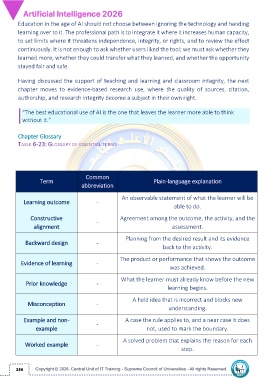
         TABLE 6-23: GLOSSARY OF ESSENTIAL TERMS


                                       Common
                   Term                                              Plain-language explanation
                                     abbreviation

                                                       An observable statement of what the learner will be
            Learning outcome                -
                                                                              able to do.


               Constructive                           Agreement among the outcome, the activity, and the
                                            -
                alignment                                                     assessment.

                                                         Planning from the desired result and its evidence
            Backward design                 -
                                                                         back to the activity.

                                                      The product or performance that shows the outcome
          Evidence of learning              -
                                                                             was achieved.


                                                       What the learner must already know before the new
             Prior knowledge                -
                                                                           learning begins.

                                                            A held idea that is incorrect and blocks new
             Misconception                  -
                                                                            understanding.


            Example and non-                             A case the rule applies to, and a near case it does
                                            -
                 example                                          not, used to mark the boundary.


                                                        A solved problem that explains the reason for each
            Worked example                  -
                                                                                  step.


        286

