


Page 27 - CyberSecurityEssentialsEnglish
P. 27
may  produce  highly useful  results,  but  they  do  not  possess  human  experience,  with  its
         meaning, values, and responsibility.


         It is useful to distinguish the model, the application, and the way the system is used. A model
         may be able to summarize text, while an application adds an interface for search, file access,

         or action execution. The user then defines the objective, data, and review criteria. Two
         applications may use the same model, yet one may be more accurate because it consults
         reliable sources, or more risky because it can execute commands. We should not judge the

         entire field of AI from one application experience.
         Essential Terms

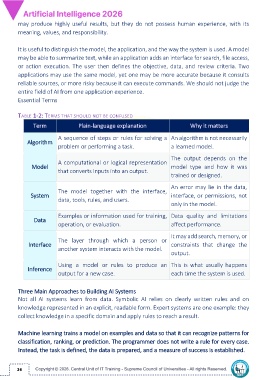
         TABLE 1-2: TERMS THAT SHOULD NOT BE CONFUSED

                Term                Plain-language explanation                        Why it matters

                           A sequence of steps or rules for solving a  An algorithm is not necessarily
             Algorithm
                           problem or performing a task.                     a learned model.

                                                                             The  output  depends  on  the
                           A computational or logical representation
               Model                                                         model  type  and  how  it  was
                           that converts inputs into an output.
                                                                             trained or designed.

                                                                             An error may lie in the data,
                           The  model  together  with  the  interface,
               System                                                        interface, or permissions, not
                           data, tools, rules, and users.
                                                                             only in the model.

                           Examples or information used for training,  Data  quality  and  limitations
                Data
                           operation, or evaluation.                         affect performance.


                                                                             It may add search, memory, or
                           The  layer  through  which  a  person  or
              Interface                                                      constraints  that  change  the
                           another system interacts with the model.
                                                                             output.


                           Using  a  model  or  rules  to  produce  an  This  is  what  usually  happens
             Inference
                           output for a new case.                            each time the system is used.


         Three Main Approaches to Building AI Systems
         Not  all  AI  systems  learn  from  data.  Symbolic  AI  relies  on  clearly  written  rules  and  on
         knowledge represented in an explicit, readable form. Expert systems are one example: they

         collect knowledge in a specific domain and apply rules to reach a result.


         Machine learning trains a model on examples and data so that it can recognize patterns for
         classification, ranking, or prediction. The programmer does not write a rule for every case.
         Instead, the task is defined, the data is prepared, and a measure of success is established.


         26

