


Page 32 - CyberSecurityEssentialsEnglish
P. 32
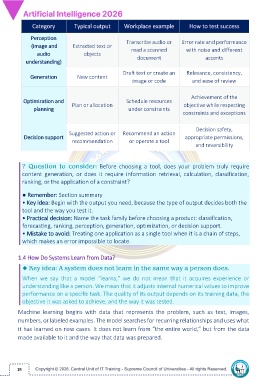
Category           Typical output        Workplace example            How to test success


               Perception
                                                         Transcribe audio or      Error rate and performance
               (image and        Extracted text or
                                                           read a scanned           with noise and different
                  audio               objects
                                                              document                      accents
            understanding)


                                                        Draft text or create an     Relevance, consistency,
               Generation          New content
                                                            image or code             and ease of review


                                                                                      Achievement of the
           Optimization and                              Schedule resources
                                 Plan or allocation                                objective while respecting
                planning                                  under constraints
                                                                                  constraints and exceptions


                                                                                        Decision safety,
                                Suggested action or     Recommend an action
            Decision support                                                       appropriate permissions,
                                 recommendation           or operate a tool
                                                                                        and reversibility


           ?  Question  to  consider:  Before  choosing  a  tool,  does  your  problem  truly  require
           content  generation,  or  does  it  require  information  retrieval,  calculation,  classification,

           ranking, or the application of a constraint?

           ● Remember: Section summary
           • Key idea: Begin with the output you need, because the type of output decides both the

           tool and the way you test it.
           • Practical decision: Name the task family before choosing a product: classification,
           forecasting, ranking, perception, generation, optimization, or decision support.
           • Mistake to avoid: Treating one application as a single tool when it is a chain of steps,
           which makes an error impossible to locate.

         1.4 How Do Systems Learn from Data?

           ◆ Key idea: A system does not learn in the same way a person does.

           When  we  say  that  a  model  “learns,”  we  do  not  mean  that  it  acquires  experience  or
           understanding like a person. We mean that it adjusts internal numerical values to improve

           performance on a specific task. The quality of its output depends on its training data, the
           objective it was asked to achieve, and the way it was tested.

         Machine  learning  begins  with  data  that  represents  the  problem,  such  as  text,  images,
         numbers, or labeled examples. The model searches for recurring relationships and uses what
         it has learned on new cases. It does not learn from “the entire world,” but from the data

         made available to it and the way that data was prepared.


         31

