


Page 223 - CyberSecurityEssentialsEnglish
P. 223
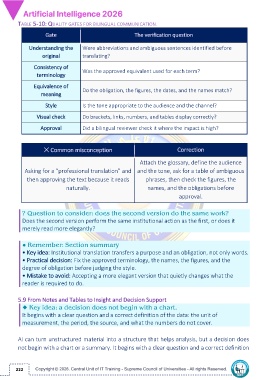
TABLE 5-10: QUALITY GATES FOR BILINGUAL COMMUNICATION

                     Gate                                    The verification question


              Understanding the       Were abbreviations and ambiguous sentences identified before
                    original          translating?

                Consistency of
                                      Was the approved equivalent used for each term?
                 terminology

                Equivalence of
                                      Do the obligation, the figures, the dates, and the names match?
                   meaning

                     Style            Is the tone appropriate to the audience and the channel?


                 Visual check         Do brackets, links, numbers, and tables display correctly?

                   Approval           Did a bilingual reviewer check it where the impact is high?


                     ✕ Common misconception                                     Correction

                                                               Attach the glossary, define the audience
            Asking for a “professional translation” and  and the tone, ask for a table of ambiguous

             then approving the text because it reads             phrases, then check the figures, the
                              naturally.                           names, and the obligations before

                                                                                 approval.

           ? Question to consider: does the second version do the same work?
           Does the second version perform the same institutional action as the first, or does it
           merely read more elegantly?


           ● Remember: Section summary
           • Key idea: Institutional translation transfers a purpose and an obligation, not only words.
           • Practical decision: Fix the approved terminology, the names, the figures, and the
           degree of obligation before judging the style.

           • Mistake to avoid: Accepting a more elegant version that quietly changes what the
           reader is required to do.

         5.9 From Notes and Tables to Insight and Decision Support
           ◆ Key idea: a decision does not begin with a chart.
           It begins with a clear question and a correct definition of the data: the unit of

           measurement, the period, the source, and what the numbers do not cover.


         AI can turn unstructured material into a structure that helps analysis, but a decision does

         not begin with a chart or a summary. It begins with a clear question and a correct definition


        222

