


Page 214 - CyberSecurityEssentialsEnglish
P. 214
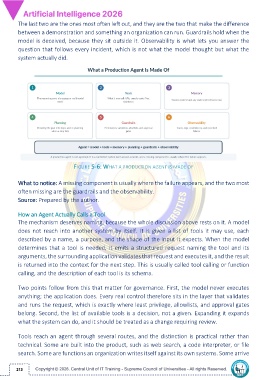
The last two are the ones most often left out, and they are the two that make the difference
         between a demonstration and something an organization can run. Guardrails hold when the
         model is deceived, because they sit outside it. Observability is what lets you answer the

         question that follows every incident, which is not what the model thought but what the
         system actually did.


                                  FIGURE 5-6: WHAT A PRODUCTION AGENT IS MADE OF


         What to notice: A missing component is usually where the failure appears, and the two most
         often missing are the guardrails and the observability.

         Source: Prepared by the author.

         How an Agent Actually Calls a Tool
         The mechanism deserves naming, because the whole discussion above rests on it. A model
         does not reach into another system by itself. It is given a list of tools it may use, each

         described by a name, a purpose, and the shape of the input it expects. When the model
         determines that a tool is needed, it emits a structured request naming the tool and its
         arguments, the surrounding application validates that request and executes it, and the result
         is returned into the context for the next step. This is usually called tool calling or function

         calling, and the description of each tool is its schema.

         Two points follow from this that matter for governance. First, the model never executes
         anything; the application does. Every real control therefore sits in the layer that validates

         and runs the request, which is exactly where least privilege, allowlists, and approval gates
         belong. Second, the list of available tools is a decision, not a given. Expanding it expands
         what the system can do, and it should be treated as a change requiring review.

         Tools reach an agent through several routes, and the distinction is practical rather than

         technical. Some are built into the product, such as web search, a code interpreter, or file
         search. Some are functions an organization writes itself against its own systems. Some arrive


        213

