


Page 213 - CyberSecurityEssentialsEnglish
P. 213
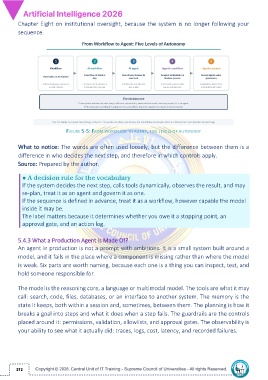
Chapter Eight on institutional oversight, because the system is no longer following your
         sequence.


                              FIGURE 5-5: FROM WORKFLOW TO AGENT, FIVE LEVELS OF AUTONOMY


         What to notice: The words are often used loosely, but the difference between them is a
         difference in who decides the next step, and therefore in which controls apply.

         Source: Prepared by the author.

           ● A decision rule for the vocabulary
           If the system decides the next step, calls tools dynamically, observes the result, and may

           re-plan, treat it as an agent and govern it as one.
           If the sequence is defined in advance, treat it as a workflow, however capable the model
           inside it may be.
           The label matters because it determines whether you owe it a stopping point, an
           approval gate, and an action log.


         5.4.3 What a Production Agent Is Made Of?
         An agent in production is not a prompt with ambitions. It is a small system built around a
         model, and it fails in the place where a component is missing rather than where the model

         is weak. Six parts are worth naming, because each one is a thing you can inspect, test, and
         hold someone responsible for.

         The model is the reasoning core, a language or multimodal model. The tools are what it may
         call: search, code, files, databases, or an interface to another system. The memory is the

         state it keeps, both within a session and, sometimes, between them. The planning is how it
         breaks a goal into steps and what it does when a step fails. The guardrails are the controls
         placed around it: permissions, validation, allowlists, and approval gates. The observability is

         your ability to see what it actually did: traces, logs, cost, latency, and recorded failures.


        212

