


Page 270 - CyberSecurityEssentialsEnglish
P. 270
adopted a three-layer answer: a summary, the steps, and an official link. This is an example
         of support improvement requiring service design, not merely a language model.

           ⚠ Warning: the limits of an automated assistant
           Do not use an automated assistant to diagnose mental health, determine eligibility for a

           sensitive service, issue a disciplinary decision, or close off the route to human contact.
           The limits of escalation must be explicit and tested.

         6.6.2 Learning Analytics: What Do We Collect, and Why?

         Learning analytics can help reveal general patterns: questions students repeat, a step where
         they stop, or a type of feedback they do not understand. But its educational value depends
         on controlling the purpose and the data. Do not gather everything that can be gathered;
         gather only what serves the improvement of teaching or support, with the least possible

         personal identification.

         Before using analytics, ask: are we analyzing to improve the activity, or to judge the student?
         Do learners know what is being collected? Can the result be interpreted pedagogically? And

         what is the risk of labelling if a student is described early as “weak” or “at risk”? Good analysis
         opens a door to early human support; it does not issue a final verdict on a learner’s future.

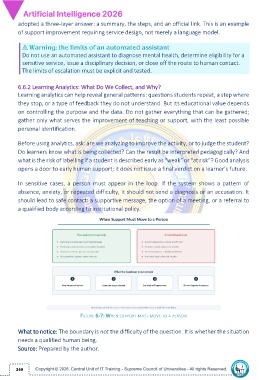
         In  sensitive  cases,  a  person  must  appear  in  the  loop.  If  the  system  shows  a  pattern  of
         absence, anxiety, or repeated difficulty, it should not send a diagnosis or an accusation. It

         should lead to safe contact: a supportive message, the option of a meeting, or a referral to
         a qualified body according to institutional policy.


                                     FIGURE 6-7: WHEN SUPPORT MUST MOVE TO A PERSON


         What to notice: The boundary is not the difficulty of the question. It is whether the situation
         needs a qualified human being.

         Source: Prepared by the author.


        269

