


Page 266 - CyberSecurityEssentialsEnglish
P. 266
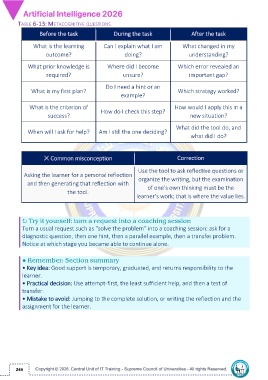
TABLE 6-13: METACOGNITIVE QUESTIONS

                   Before the task                  During the task                   After the task

                What is the learning           Can I explain what I am            What changed in my
                     outcome?                           doing?                       understanding?


             What prior knowledge is             Where did I become             Which error revealed an
                      required?                         unsure?                      important gap?

                                                Do I need a hint or an
               What is my first plan?                                           Which strategy worked?
                                                       example?

              What is the criterion of                                         How would I apply this in a
                                              How do I check this step?
                      success?                                                       new situation?

                                                                               What did the tool do, and
             When will I ask for help?       Am I still the one deciding?
                                                                                      what did I do?


                     ✕ Common misconception                                     Correction

                                                              Use the tool to ask reflective questions or
            Asking the learner for a personal reflection
                                                               organize the writing, but the examination
             and then generating that reflection with
                                                                   of one’s own thinking must be the
                               the tool.
                                                              learner’s work; that is where the value lies.


           ↻ Try it yourself: turn a request into a coaching session
           Turn a usual request such as “solve the problem” into a coaching session: ask for a

           diagnostic question, then one hint, then a parallel example, then a transfer problem.
           Notice at which stage you became able to continue alone.

           ● Remember: Section summary
           • Key idea: Good support is temporary, graduated, and returns responsibility to the

           learner.
           • Practical decision: Use attempt-first, the least sufficient help, and then a test of
           transfer.
           • Mistake to avoid: Jumping to the complete solution, or writing the reflection and the
           assignment for the learner.


        265

