


Page 269 - CyberSecurityEssentialsEnglish
P. 269
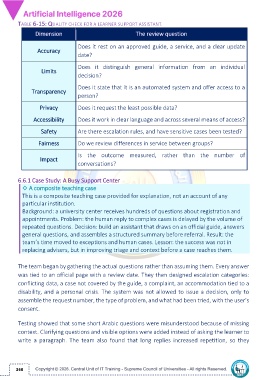
TABLE 6-15: QUALITY CHECK FOR A LEARNER SUPPORT ASSISTANT

                 Dimension                                   The review question

                                    Does it rest on an approved guide, a service, and a clear update
                  Accuracy
                                    date?


                                    Does  it  distinguish  general  information  from  an  individual
                   Limits
                                    decision?

                                    Does it state that it is an automated system and offer access to a
               Transparency
                                    person?

                   Privacy          Does it request the least possible data?

                Accessibility       Does it work in clear language and across several means of access?


                   Safety           Are there escalation rules, and have sensitive cases been tested?

                  Fairness          Do we review differences in service between groups?

                                    Is  the  outcome  measured,  rather  than  the  number  of
                   Impact
                                    conversations?


         6.6.1 Case Study: A Busy Support Center
           ◇ A composite teaching case

           This is a composite teaching case provided for explanation, not an account of any
           particular institution.
           Background: a university center receives hundreds of questions about registration and
           appointments. Problem: the human reply to complex cases is delayed by the volume of
           repeated questions. Decision: build an assistant that draws on an official guide, answers
           general questions, and assembles a structured summary before referral. Result: the
           team’s time moved to exceptions and human cases. Lesson: the success was not in
           replacing advisers, but in improving triage and context before a case reaches them.


         The team began by gathering the actual questions rather than assuming them. Every answer
         was tied to an official page with a review date. They then designed escalation categories:

         conflicting data, a case not covered by the guide, a complaint, an accommodation tied to a
         disability, and a personal crisis. The system was not allowed to issue a decision, only to
         assemble the request number, the type of problem, and what had been tried, with the user’s

         consent.

         Testing showed that some short Arabic questions were misunderstood because of missing
         context. Clarifying questions and visible options were added instead of asking the learner to

         write  a  paragraph.  The  team  also  found  that  long  replies  increased  repetition,  so  they


        268

