


Page 70 - CyberSecurityEssentialsEnglish
P. 70
+ Methodological note: what PACFT is, and what it is not
           PACFT is a teaching aid prepared by the author that gathers purpose, audience, context,
           format, and tone. It helps you recall questions that recur in everyday prompting. It is not
           an international standard, and it is not a substitute for source material, constraints, and

           success criteria when a task demands higher precision.
         P stands for purpose: why do we need the output? To inform, to explain, to support a
         decision, or to prepare for a meeting. The purpose differs from the task. The task may be
         “summarize”, while the purpose is “enable the manager to choose a course of action within

         five minutes.”

         A stands for audience: who will use the output, what is their level of knowledge, and what
         do they need to do? Defining the audience prevents a specialist explanation being handed

         to  a  general  reader,  or  an  introductory  text  being  handed  to  a  committee  that  needs
         evidence.

         C stands for context: what background, circumstances, and constraints make the request
         specific to our case? Context is the information that has an effect, not the whole history of

         the subject.

         F stands for format: how will the output be delivered and used? The number of sections, the
         order, the fields,  the table,  the length.  A good format reduces reformatting and makes
         review faster.


         T stands for tone: how should the writing sound? Direct, objective, friendly, firm without

         aggression, or instructional. The tone must serve the purpose and the audience rather than
         becoming decoration detached from the task.


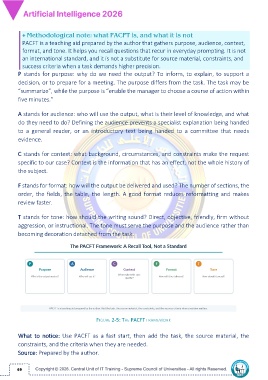
                                            FIGURE 2-5: THE PACFT FRAMEWORK

         What  to  notice:  Use  PACFT  as  a  fast  start,  then  add  the  task,  the  source  material,  the
         constraints, and the criteria when they are needed.

         Source: Prepared by the author.


         69

