


Page 69 - CyberSecurityEssentialsEnglish
P. 69
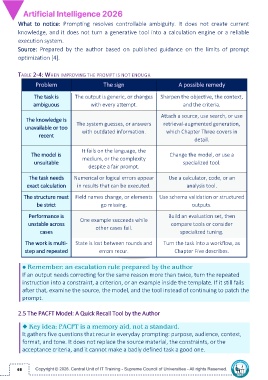
What  to  notice:  Prompting  resolves  controllable  ambiguity.  It  does  not  create  current
         knowledge, and it does not turn a generative tool into a calculation engine or a reliable
         execution system.

         Source:  Prepared  by  the  author  based  on  published  guidance  on  the  limits  of  prompt
         optimization [4].


         TABLE 2-4: WHEN IMPROVING THE PROMPT IS NOT ENOUGH

                 Problem                       The sign                         A possible remedy

                The task is       The output is generic, or changes     Sharpen the objective, the context,
                ambiguous                with every attempt.                      and the criteria.

                                                                         Attach a source, use search, or use
             The knowledge is
                                   The system guesses, or answers         retrieval-augmented generation,
            unavailable or too
                                     with outdated information.            which Chapter Three covers in
                  recent
                                                                                       detail.

                                      It fails on the language, the
               The model is                                                 Change the model, or use a
                                      medium, or the complexity
                unsuitable                                                        specialized tool.
                                        despite a fair prompt.

              The task needs      Numerical or logical errors appear        Use a calculator, code, or an

             exact calculation     in results that can be executed.                 analysis tool.

            The structure must  Field names change, or elements  Use schema validation or structured
                 be strict                    go missing.                             outputs.

              Performance is                                                Build an evaluation set, then
                                     One example succeeds while
              unstable across                                                compare tools or consider
                                            other cases fail.
                   cases                                                         specialized tuning.

            The work is multi-     State is lost between rounds and       Turn the task into a workflow, as
            step and repeated                errors recur.                     Chapter Five describes.


           ● Remember: an escalation rule prepared by the author
           If an output needs correcting for the same reason more than twice, turn the repeated

           instruction into a constraint, a criterion, or an example inside the template. If it still fails
           after that, examine the source, the model, and the tool instead of continuing to patch the
           prompt.

         2.5 The PACFT Model: A Quick Recall Tool by the Author

           ◆ Key idea: PACFT is a memory aid, not a standard.

           It gathers five questions that recur in everyday prompting: purpose, audience, context,
           format, and tone. It does not replace the source material, the constraints, or the
           acceptance criteria, and it cannot make a badly defined task a good one.


         68

