


Page 68 - CyberSecurityEssentialsEnglish
P. 68
2.4 From a Simple Prompt to a Professional One

           ◆ Key idea: the right length of a prompt is set by the task, not by habit.

           A simple request suits a small task with low risk and an output you can check at a glance.
           A structured or professional prompt earns its extra length only when the task is repeated,
           sensitive, or expensive to review.

         A simple prompt is appropriate when the task is small, the risk is low, and the output is easy

         to review. For example: “Suggest ten short titles for an article on time management.” No
         long template is needed here. A structured prompt adds an audience and a format or an
         example. A professional prompt adds material, constraints, and criteria, because the task is

         repeated, sensitive, or expensive to review.

         The quality of a prompt is not measured by its word count. It is measured by the time it takes

         to reach an acceptable output and by how stable that output is across different cases. A
         structured prompt may cost one extra minute and save three rounds of correction. A long

         prompt may be slower and worse, because it repeats instructions or creates conflicts.


              Level                   Suits                                   Example

                            A small, clearly defined         Explain this concept in four lines with an
             Simple
                                question or task.                             example.

                                                           Explain it to a beginner in three paragraphs,
                           An output that needs an
           Structured                                      then add an example and a comprehension
                            audience and a format.
                                                                              question.

                            A task that is repeated,      Use only the attached material, state what it
          Professional        precise, or costly to           does not clarify, and follow a defined

                                     review.                               acceptance list.
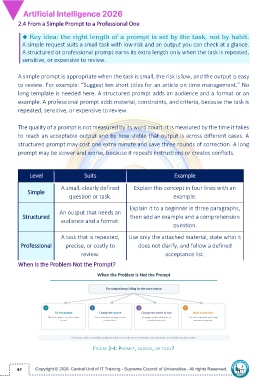
         When Is the Problem Not the Prompt?


                                          FIGURE 2-4: PROMPT, SOURCE, OR TOOL?


         67

