


Page 48 - CyberSecurityEssentialsEnglish
P. 48
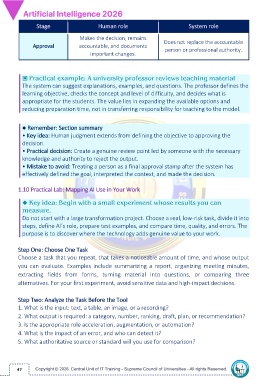
Stage                       Human role                              System role


                                    Makes the decision, remains
                                                                          Does not replace the accountable
                Approval            accountable, and documents
                                                                          person or professional authority.
                                         important changes.


           ▣ Practical example: A university professor reviews teaching material
           The system can suggest explanations, examples, and questions. The professor defines the
           learning objective, checks the concept and level of difficulty, and decides what is
           appropriate for the students. The value lies in expanding the available options and
           reducing preparation time, not in transferring responsibility for teaching to the model.


           ● Remember: Section summary
           • Key idea: Human judgment extends from defining the objective to approving the
           decision.
           • Practical decision: Create a genuine review point led by someone with the necessary
           knowledge and authority to reject the output.
           • Mistake to avoid: Treating a person as a final approval stamp after the system has
           effectively defined the goal, interpreted the context, and made the decision.


         1.10 Practical Lab: Mapping AI Use in Your Work

           ◆ Key idea: Begin with a small experiment whose results you can

           measure.
           Do not start with a large transformation project. Choose a real, low-risk task, divide it into
           steps, define AI’s role, prepare test examples, and compare time, quality, and errors. The
           purpose is to discover where the technology adds genuine value to your work.

         Step One: Choose One Task
         Choose a task that you repeat, that takes a noticeable amount of time, and whose output

         you  can  evaluate.  Examples  include  summarizing  a  report,  organizing  meeting  minutes,
         extracting  fields  from  forms,  turning  material  into  questions,  or  comparing  three

         alternatives. For your first experiment, avoid sensitive data and high-impact decisions.

         Step Two: Analyze the Task Before the Tool
         1. What is the input: text, a table, an image, or a recording?

         2. What output is required: a category, number, ranking, draft, plan, or recommendation?
         3. Is the appropriate role acceleration, augmentation, or automation?

         4. What is the impact of an error, and who can detect it?
         5. What authoritative source or standard will you use for comparison?


         47

