


Page 354 - CyberSecurityEssentialsEnglish
P. 354
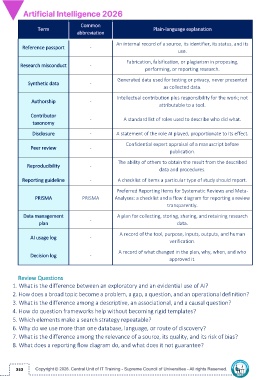
Common
                  Term                                               Plain-language explanation
                                   abbreviation


                                                     An internal record of a source, its identifier, its status, and its
           Reference passport            -
                                                                                use.
                                                         Fabrication, falsification, or plagiarism in proposing,
          Research misconduct            -
                                                                  performing, or reporting research.
                                                     Generated data used for testing or privacy, never presented
             Synthetic data              -
                                                                          as collected data.
                                                     Intellectual contribution plus responsibility for the work; not
               Authorship                -
                                                                        attributable to a tool.

               Contributor
                                         -              A standard list of roles used to describe who did what.
                taxonomy

               Disclosure                -           A statement of the role AI played, proportionate to its effect.

                                                         Confidential expert appraisal of a manuscript before
               Peer review               -
                                                                            publication.

                                                     The ability of others to obtain the result from the described
             Reproducibility             -
                                                                        data and procedures.

           Reporting guideline           -           A checklist of items a particular type of study should report.

                                                     Preferred Reporting Items for Systematic Reviews and Meta-
                 PRISMA               PRISMA        Analyses: a checklist and a flow diagram for reporting a review
                                                                           transparently.

           Data management                           A plan for collecting, storing, sharing, and retaining research
                                         -
                  plan                                                          data.

                                                      A record of the tool, purpose, inputs, outputs, and human
               AI usage log              -
                                                                            verification.

                                                      A record of what changed in the plan, why, when, and who
               Decision log              -
                                                                            approved it.


         Review Questions
       1. What is the difference between an exploratory and an evidential use of AI?

       2. How does a broad topic become a problem, a gap, a question, and an operational definition?
       3. What is the difference among a descriptive, an associational, and a causal question?
       4. How do question frameworks help without becoming rigid templates?

       5. Which elements make a search strategy repeatable?
       6. Why do we use more than one database, language, or route of discovery?
       7. What is the difference among the relevance of a source, its quality, and its risk of bias?

       8. What does a reporting flow diagram do, and what does it not guarantee?


        353

