


Page 34 - CyberSecurityEssentialsEnglish
P. 34
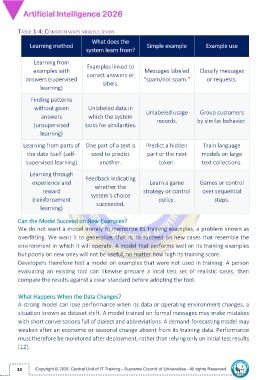
TABLE 1-4: COMMON WAYS MODELS LEARN

                                          What does the
              Learning method                                     Simple example             Example use
                                       system learn from?

                Learning from
                                        Examples linked to
                examples with                                    Messages labeled         Classify messages
                                        correct answers or
             answers (supervised                                 “spam/not spam.”            or requests.
                                               labels.
                   learning)

               Finding patterns
                without given           Unlabeled data in
                                                                  Unlabeled usage         Group customers
                   answers              which the system
                                                                       records.          by similar behavior.
                (unsupervised          looks for similarities.
                   learning)


           Learning from parts of  One part of a text is          Predict a hidden         Train language
             the data itself (self-       used to predict         part or the next         models on large
             supervised learning)            another.                   token.             text collections.


              Learning through
                                       Feedback indicating
               experience and                                       Learn a game          Games or control
                                           whether the
                    reward                                       strategy or control       over sequential
                                         system’s choice
               (reinforcement                                           policy.                 steps.
                                            succeeded.
                   learning)

         Can the Model Succeed on New Examples?

         We do not want a model merely to memorize its training examples, a problem known as
         overfitting. We want it to generalize, that is, to succeed on new cases that resemble the
         environment in which it will operate. A model that performs well on its training examples

         but poorly on new ones will not be useful, no matter how high its training score.
         Developers therefore test a model on examples that were not used in training. A person
         evaluating  an  existing  tool  can  likewise  prepare  a  local  test  set  of  realistic  cases,  then

         compare the results against a clear standard before adopting the tool.

         What Happens When the Data Changes?

         A strong model can lose performance when its data or operating environment changes, a
         situation known as dataset shift. A model trained on formal messages may make mistakes
         with short conversations full of dialect and abbreviations. A demand-forecasting model may

         weaken after an economic or seasonal change absent from its training data. Performance
         must therefore be monitored after deployment, rather than relying only on initial test results
         [12].


         33

