


Page 37 - CyberSecurityEssentialsEnglish
P. 37
A model does not always treat a whole word as one unit. It may divide a word into smaller
         pieces,  then  analyze  their  relationship  to  the  context  to  estimate  what  comes  next.
         Tokenization  differs across languages,  including  Arabic and  English,  which is one  reason

         performance can vary from one language to another.


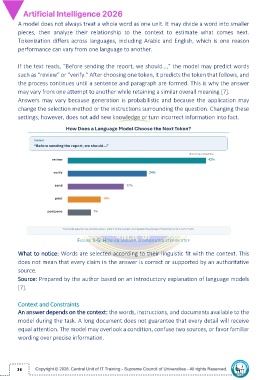
         If the text reads, “Before sending the report, we should…,” the model may predict words
         such as “review” or “verify.” After choosing one token, it predicts the token that follows, and
         the process continues until a sentence and paragraph are formed. This is why the answer

         may vary from one attempt to another while retaining a similar overall meaning [7].
         Answers  may  vary  because  generation  is  probabilistic  and  because  the  application  may
         change the selection method or the instructions surrounding the question. Changing these

         settings, however, does not add new knowledge or turn incorrect information into fact.


                                   FIGURE 1-5: HOW AN ANSWER IS GENERATED STEP BY STEP

         What to notice: Words are selected according to their linguistic fit with the context. This

         does not mean that every claim in the answer is correct or supported by an authoritative
         source.
         Source: Prepared by the author based on an introductory explanation of language models

         [7].


         Context and Constraints
         An answer depends on the context: the words, instructions, and documents available to the
         model during the task. A long document does not guarantee that every detail will receive
         equal attention. The model may overlook a condition, confuse two sources, or favor familiar

         wording over precise information.


         36

