


Page 98 - CyberSecurityEssentialsEnglish
P. 98
Step Seven: Save the Template and Its Limits
         Replace private data with parameters, and add the version number, the date of the test, and
         the names of the cases that failed. Write clearly when the template should not be used and

         what requires human review. In this way the experiment becomes an asset that can be
         improved rather than something lost inside a chat log.


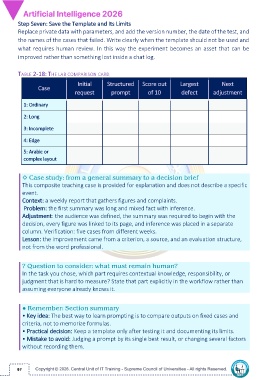
         TABLE 2-18: THE LAB COMPARISON CARD
                                    Initial      Structured     Score out        Largest            Next
                  Case
                                  request         prompt           of 10          defect        adjustment

            1: Ordinary


            2: Long

            3: Incomplete

            4: Edge

            5: Arabic or

            complex layout


           ◇ Case study: from a general summary to a decision brief
           This composite teaching case is provided for explanation and does not describe a specific

           event.
           Context: a weekly report that gathers figures and complaints.
            Problem: the first summary was long and mixed fact with inference.
           Adjustment: the audience was defined, the summary was required to begin with the
           decision, every figure was linked to its page, and inference was placed in a separate
           column. Verification: five cases from different weeks.

           Lesson: the improvement came from a criterion, a source, and an evaluation structure,
           not from the word professional.


           ? Question to consider: what must remain human?
           In the task you chose, which part requires contextual knowledge, responsibility, or
           judgment that is hard to measure? State that part explicitly in the workflow rather than
           assuming everyone already knows it.


           ● Remember: Section summary
           • Key idea: The best way to learn prompting is to compare outputs on fixed cases and
           criteria, not to memorize formulas.
           • Practical decision: Keep a template only after testing it and documenting its limits.
           • Mistake to avoid: Judging a prompt by its single best result, or changing several factors
           without recording them.


         97

