


Page 102 - CyberSecurityEssentialsEnglish
P. 102
Common
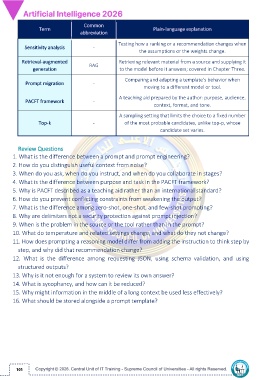
                  Term                                               Plain-language explanation
                                     abbreviation


                                                      Testing how a ranking or a recommendation changes when
            Sensitivity analysis          -
                                                               the assumptions or the weights change.
           Retrieval-augmented                        Retrieving relevant material from a source and supplying it
                                         RAG
                generation                            to the model before it answers; covered in Chapter Three.
                                                         Comparing and adapting a template’s behavior when
            Prompt migration              -
                                                                 moving to a different model or tool.

                                                      A teaching aid prepared by the author: purpose, audience,
            PACFT framework               -
                                                                     context, format, and tone.

                                                      A sampling setting that limits the choice to a fixed number
                  Top-k                   -             of the most probable candidates, unlike top-p, whose
                                                                        candidate set varies.


         Review Questions

       1. What is the difference between a prompt and prompt engineering?
       2. How do you distinguish useful context from noise?
       3. When do you ask, when do you instruct, and when do you collaborate in stages?

       4. What is the difference between purpose and task in the PACFT framework?
       5. Why is PACFT described as a teaching aid rather than an international standard?
       6. How do you prevent conflicting constraints from weakening the output?

       7. What is the difference among zero-shot, one-shot, and few-shot prompting?
       8. Why are delimiters not a security protection against prompt injection?
       9. When is the problem in the source or the tool rather than in the prompt?

       10. What do temperature and related settings change, and what do they not change?
       11. How does prompting a reasoning model differ from adding the instruction to think step by
         step, and why did that recommendation change?

       12.  What  is  the  difference  among  requesting  JSON,  using  schema  validation,  and  using
         structured outputs?

       13. Why is it not enough for a system to review its own answer?
       14. What is sycophancy, and how can it be reduced?
       15. Why might information in the middle of a long context be used less effectively?
       16. What should be stored alongside a prompt template?


        101

