


Page 96 - CyberSecurityEssentialsEnglish
P. 96
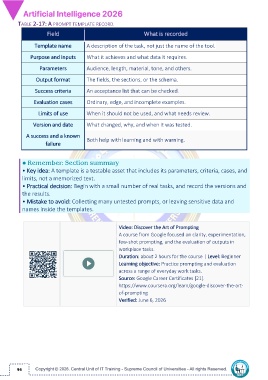
TABLE 2-17: A PROMPT TEMPLATE RECORD

                      Field                                      What is recorded

                Template name           A description of the task, not just the name of the tool.

               Purpose and inputs       What it achieves and what data it requires.

                   Parameters           Audience, length, material, tone, and others.

                 Output format          The fields, the sections, or the schema.

                 Success criteria       An acceptance list that can be checked.


                Evaluation cases        Ordinary, edge, and incomplete examples.

                  Limits of use         When it should not be used, and what needs review.

                Version and date        What changed, why, and when it was tested.

             A success and a known
                                        Both help with learning and with warning.
                     failure


           ● Remember: Section summary
           • Key idea: A template is a testable asset that includes its parameters, criteria, cases, and

           limits, not a memorized text.
           • Practical decision: Begin with a small number of real tasks, and record the versions and
           the results.
           • Mistake to avoid: Collecting many untested prompts, or leaving sensitive data and
           names inside the templates.


                                                      Video: Discover the Art of Prompting
                                                      A course from Google focused on clarity, experimentation,
                                                      few-shot prompting, and the evaluation of outputs in
                                                      workplace tasks.

                                                      Duration: about 2 hours for the course | Level: Beginner
                                                      Learning objective: Practice prompting and evaluation
                                                      across a range of everyday work tasks.

                                                      Source: Google Career Certificates [21].
                                                      https://www.coursera.org/learn/google-discover-the-art-
                                                      of-prompting
                                                      Verified: June 6, 2026


         95

