


Page 101 - CyberSecurityEssentialsEnglish
P. 101
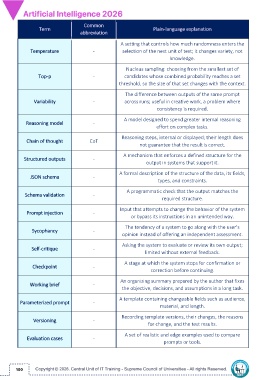
Common
                  Term                                               Plain-language explanation
                                     abbreviation


                                                       A setting that controls how much randomness enters the
               Temperature                -            selection of the next unit of text; it changes variety, not
                                                                             knowledge.
                                                         Nucleus sampling: choosing from the smallest set of
                  Top-p                   -             candidates whose combined probability reaches a set
                                                      threshold, so the size of that set changes with the context.


                                                         The difference between outputs of the same prompt
                Variability               -             across runs; useful in creative work, a problem where
                                                                       consistency is required.
                                                        A model designed to spend greater internal reasoning
             Reasoning model              -
                                                                       effort on complex tasks.

                                                       Reasoning steps, internal or displayed; their length does
             Chain of thought            CoT
                                                               not guarantee that the result is correct.

                                                        A mechanism that enforces a defined structure for the
            Structured outputs            -
                                                                  output in systems that support it.

                                                      A formal description of the structure of the data, its fields,
              JSON schema                 -
                                                                       types, and constraints.

                                                         A programmatic check that the output matches the
            Schema validation             -
                                                                         required structure.

                                                      Input that attempts to change the behavior of the system
             Prompt injection             -
                                                           or bypass its instructions in an unintended way.

                                                         The tendency of a system to go along with the user’s
               Sycophancy                 -
                                                       opinion instead of offering an independent assessment.

                                                       Asking the system to evaluate or review its own output;
               Self-critique              -
                                                                  limited without external feedback.

                                                        A stage at which the system stops for confirmation or
               Checkpoint                 -
                                                                    correction before continuing.

                                                       An organizing summary prepared by the author that fixes
              Working brief               -
                                                       the objective, decisions, and assumptions in a long task.

                                                      A template containing changeable fields such as audience,
          Parameterized prompt            -
                                                                        material, and length.

                                                       Recording template versions, their changes, the reasons
                Versioning                -
                                                                   for change, and the test results.

                                                        A set of realistic and edge examples used to compare
             Evaluation cases             -
                                                                          prompts or tools.


        100

