


Page 313 - CyberSecurityEssentialsEnglish
P. 313
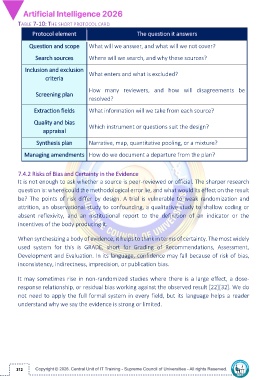
TABLE 7-10: THE SHORT PROTOCOL CARD

               Protocol element                               The question it answers

              Question and scope         What will we answer, and what will we not cover?

                 Search sources          Where will we search, and why these sources?


            Inclusion and exclusion
                                         What enters and what is excluded?
                     criteria

                                         How  many  reviewers,  and  how  will  disagreements  be
                 Screening plan
                                         resolved?

                Extraction fields        What information will we take from each source?

                Quality and bias
                                         Which instrument or questions suit the design?
                    appraisal

                 Synthesis plan          Narrative, map, quantitative pooling, or a mixture?

            Managing amendments  How do we document a departure from the plan?


         7.4.2 Risks of Bias and Certainty in the Evidence

         It is not enough to ask whether a source is peer-reviewed or official. The sharper research
         question is: where could the methodological error lie, and what would its effect on the result
         be? The  points of risk  differ by design.  A trial  is vulnerable to weak randomization and

         attrition, an observational study to confounding, a qualitative study to shallow coding or
         absent  reflexivity,  and  an  institutional  report  to  the  definition  of  an  indicator  or  the
         incentives of the body producing it.


         When synthesizing a body of evidence, it helps to think in terms of certainty. The most widely

         used  system  for  this  is  GRADE,  short  for  Grading  of  Recommendations,  Assessment,
         Development and Evaluation. In its language, confidence may fall because of risk of bias,
         inconsistency, indirectness, imprecision, or publication bias.


         It may sometimes rise in non-randomized studies where there is a large effect, a dose-

         response relationship, or residual bias working against the observed result [22][32]. We do
         not need to apply the full formal system in every field, but its language helps a reader

         understand why we say the evidence is strong or limited.


        312

