


Page 300 - CyberSecurityEssentialsEnglish
P. 300
reasoning.  Even  so,  sensitive  data  must  be  protected,  and  interviews,  manuscripts,  or
         unpublished results must not be uploaded to public tools that the institution or the ethical
         approval does not permit.


         In research there is a difference between a source and an assistant. A source is material that

         can be cited and inspected: an article, a report, data, a legal document, an interview, a
         record, or a methodological note. A generative model is an intermediary that helps you work

         with  such  materials,  and  it  should  not  automatically  be  treated  as  a  witness  to  the
         correctness of their content. When a system says “studies indicate”, the first question is:
         which studies? And did the tool actually read them, or did it construct a probable sentence?

         International guidance proposes a human-centered approach in education and research,
         with  protection  of  privacy,  ethical  review,  and  transparency  [1].  In  scientific  publishing,
         editorial guidance affirms that human beings remain responsible for accuracy, originality,

         and citations, and that AI tools are not listed as authors [12][13]. These principles are not
         obstacles to productivity; they prevent time being lost correcting errors that could have
         been avoided from the outset.


         The best use is not always the most complex. Creating a simple evidence matrix, a reference

         checklist, or a query log may be more valuable than building an autonomous research agent.
         Design begins from the real bottleneck: is the problem finding the sources, reading them,

         organizing them, comparing them, or writing? Then the tool is used at the point that raises
         speed without hiding the origin of the information.

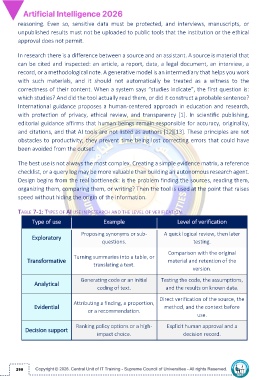
         TABLE 7-1: TYPES OF AI USE IN RESEARCH AND THE LEVEL OF VERIFICATION

               Type of use                     Example                          Level of verification

                                     Proposing synonyms or sub-           A quick logical review, then later
               Exploratory
                                              questions.                               testing.

                                                                            Comparison with the original
                                  Turning summaries into a table, or
             Transformative                                                 material and retention of the
                                           translating a text.
                                                                                       version.

                                     Generating code or an initial       Testing the code, the assumptions,
                Analytical
                                            coding of text.                and the results on known data.

                                                                        Direct verification of the source, the
                                  Attributing a finding, a proportion,
                Evidential                                                method, and the context before
                                        or a recommendation.
                                                                                         use.


                                   Ranking policy options or a high-       Explicit human approval and a
            Decision support
                                            impact choice.                        decision record.


        299

