


Page 253 - CyberSecurityEssentialsEnglish
P. 253
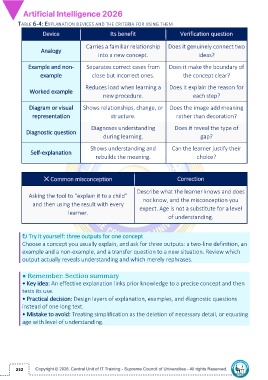
TABLE 6-4: EXPLANATION DEVICES AND THE CRITERIA FOR USING THEM

                    Device                        Its benefit                    Verification question

                                       Carries a familiar relationship      Does it genuinely connect two
                   Analogy
                                             into a new concept.                         ideas?


              Example and non-         Separates correct cases from         Does it make the boundary of
                   example                close but incorrect ones.               the concept clear?

                                       Reduces load when learning a         Does it explain the reason for
              Worked example
                                               new procedure.                          each step?

              Diagram or visual       Shows relationships, change, or  Does the image add meaning
               representation                     structure.                   rather than decoration?


                                          Diagnoses understanding              Does it reveal the type of
             Diagnostic question
                                               during learning.                           gap?

                                         Shows understanding and             Can the learner justify their
               Self-explanation
                                            rebuilds the meaning.                        choice?


                     ✕ Common misconception                                     Correction

                                                              Describe what the learner knows and does
              Asking the tool to “explain it to a child”
                                                                 not know, and the misconception you
                and then using the result with every
                                                               expect. Age is not a substitute for a level
                               learner.
                                                                            of understanding.


           ↻ Try it yourself: three outputs for one concept
           Choose a concept you usually explain, and ask for three outputs: a two-line definition, an
           example and a non-example, and a transfer question to a new situation. Review which
           output actually reveals understanding and which merely rephrases.

           ● Remember: Section summary

           • Key idea: An effective explanation links prior knowledge to a precise concept and then
           tests its use.
           • Practical decision: Design layers of explanation, examples, and diagnostic questions
           instead of one long text.
           • Mistake to avoid: Treating simplification as the deletion of necessary detail, or equating
           age with level of understanding.


        252

