


Page 115 - CyberSecurityEssentialsEnglish
P. 115
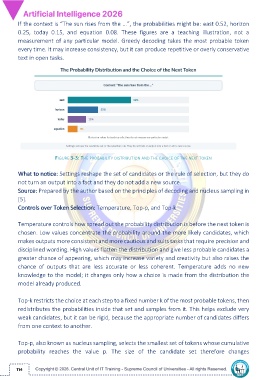
If the context is “The sun rises from the ...”, the probabilities might be: east 0.52, horizon
         0.25,  today  0.15,  and  equation  0.08.  These  figures  are  a  teaching  illustration,  not  a
         measurement of any particular model. Greedy decoding takes the most probable token

         every time. It may increase consistency, but it can produce repetitive or overly conservative
         text in open tasks.


                          FIGURE 3-3: THE PROBABILITY DISTRIBUTION AND THE CHOICE OF THE NEXT TOKEN

         What to notice: Settings reshape the set of candidates or the rule of selection, but they do

         not turn an output into a fact and they do not add a new source.
         Source: Prepared by the author based on the principles of decoding and nucleus sampling in
         [5].

         Controls over Token Selection: Temperature, Top-p, and Top-k

         Temperature controls how spread out the probability distribution is before the next token is

         chosen. Low values concentrate the probability around the more likely candidates, which
         makes outputs more consistent and more cautious and suits tasks that require precision and
         disciplined wording. High values flatten the distribution and give less probable candidates a

         greater chance of appearing, which may increase variety and creativity but also raises the
         chance  of  outputs  that  are  less  accurate  or  less  coherent.  Temperature  adds  no  new
         knowledge to the model; it changes only how a choice is made from the distribution the

         model already produced.

         Top-k restricts the choice at each step to a fixed number k of the most probable tokens, then

         redistributes the probabilities inside that set and samples from it. This helps exclude very
         weak candidates, but it can be rigid, because the appropriate number of candidates differs

         from one context to another.

         Top-p, also known as nucleus sampling, selects the smallest set of tokens whose cumulative
         probability  reaches  the  value  p.  The  size  of  the  candidate  set  therefore  changes


        114

