


Page 116 - CyberSecurityEssentialsEnglish
P. 116
automatically according to how sharp the distribution is: the set may be small when one
         candidate dominates, and it widens when the probability is spread across several candidates.
         These mechanisms may be used alone or together. The order in which temperature and the

         filters are applied differs between systems and generation libraries, and it is not a fixed rule.
         What matters in practice is that you record the settings you used and observe their effect

         on your own cases, rather than assuming one universal order [5].

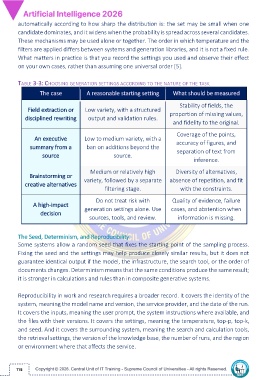
         TABLE 3-3: CHOOSING GENERATION SETTINGS ACCORDING TO THE NATURE OF THE TASK

                   The case             A reasonable starting setting         What should be measured

                                                                                 Stability of fields, the
             Field extraction or       Low variety, with a structured
                                                                            proportion of missing values,
            disciplined rewriting       output and validation rules.
                                                                              and fidelity to the original.

                                                                                Coverage of the points,
                An executive           Low to medium variety, with a
                                                                               accuracy of figures, and
              summary from a            ban on additions beyond the
                                                                                separation of text from
                    source                          source.
                                                                                       inference.

                                         Medium or relatively high             Diversity of alternatives,
              Brainstorming or
                                      variety, followed by a separate       absence of repetition, and fit
            creative alternatives
                                                filtering stage.                 with the constraints.

                                            Do not treat risk with            Quality of evidence, failure
                A high-impact
                                       generation settings alone. Use        cases, and abstention when
                   decision
                                         sources, tools, and review.            information is missing.


         The Seed, Determinism, and Reproducibility
         Some systems allow a random seed that fixes the starting point of the sampling process.
         Fixing the seed and the settings may help produce closely similar results, but it does not

         guarantee identical output if the model, the infrastructure, the search tool, or the order of
         documents changes. Determinism means that the same conditions produce the same result;
         it is stronger in calculations and rules than in composite generative systems.


         Reproducibility in work and research requires a broader record. It covers the identity of the
         system, meaning the model name and version, the service provider, and the date of the run.

         It covers the inputs, meaning the user prompt, the system instructions where available, and
         the files with their versions. It covers the settings, meaning the temperature, top-p, top-k,
         and seed. And it covers the surrounding system, meaning the search and calculation tools,

         the retrieval settings, the version of the knowledge base, the number of runs, and the region
         or environment where that affects the service.


        115

