


Page 33 - CyberSecurityEssentialsEnglish
P. 33
Number Spoofing

       Scammers and dishonest telemarketers are constantly developing new tactics to trick people into returning
       their calls. Most phones have call screening features, which reveal caller information when the phone rings.

       Information has become a more and more popular tactic that hackers use. To make it appear as though the
       calls are coming from a different individual or company, Phone Number Spoofing causes the receipient's
       Caller ID to falsify the information about an incoming call.

       Even though the caller's information might seem local, telemarketers from other countries frequently place
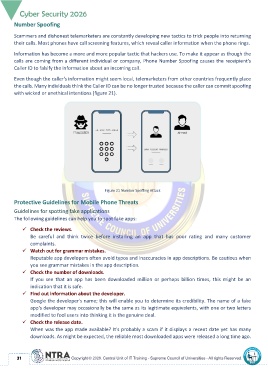
       the calls. Many individuals think the Caller ID can be no longer trusted because the caller can commit spoofing
       with wicked or unethical intentions (figure 21).


                                                Figure 21 Number Spoffing Attack

       Protective Guidelines for Mobile Phone Threats

       Guidelines for spotting fake applications
       The following guidelines can help you to spot fake apps:

           ✓  Check the reviews.
               Be  careful  and  think  twice  before  installing  an  app  that  has  poor  rating  and  many  customer
               complaints.
           ✓  Watch out for grammar mistakes.
               Reputable app developers often avoid typos and inaccuracies in app descriptions. Be cautious when
               you see grammar mistakes in the app description.
           ✓  Check the number of downloads.
               If  you  see  that  an  app  has  been  downloaded  million  or  perhaps  billion  times,  this  might  be  an
               indication that it is safe.
           ✓  Find out information about the developer.
               Google the developer's name; this will enable you to determine its credibility. The name of a fake
               app's developer may occasionally be the same as its legitimate equivalents, with one or two letters
               modified to fool users into thinking it is the genuine deal.
           ✓  Check the release date.
               When was the app made available? It's probably a scam if it displays a recent date yet has many
               downloads. As might be expected, the reliable most downloaded apps were released a long time ago.


          31

