


Page 29 - CyberSecurityEssentialsEnglish
P. 29
✓  Manually Block the Sender.
               You should manually construct a blocked senders list if your email program lets you. Then, add the
               sender to the prohibited list after noting the sender's email domain.
           ✓  Purchase an Extra Line of Security.
               Never fall on the side of safety. Think about investing in an antivirus software to keep an eye on your
               email.

       WiFi-related threats
       Most people have at least one internet-connected gadget in today's connected world. As these devices grow,
       it  is  crucial  to  create  a  security  policy  to  reduce  the  risk  of  abuse.  Cybercriminals  may  utilize  internet-
       connected gadgets to gather personal data, steal identities, jeopardise financial information, and covertly
       listen to—or watch—users. The use and configuration of your devices can help stop this kind of behaviors, if
       you take a few safeguards. Therefore, this section identifies potential attacks on your home network and
       provides tips on protecting it.

       Private/Home Network Access Threats
       According to the Cybersecurity and Infrastructure Security Agency (CISA), the US-CERT, there are several risks
       when it comes to your home or private network; main risks are namely the following:

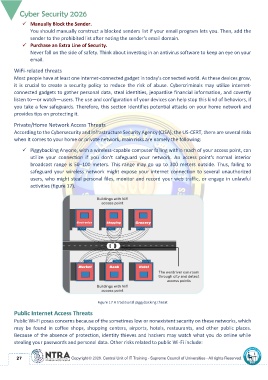
           ✓  Piggybacking Anyone, with a wireless-capable computer falling within reach of your access point, can
               utilize  your  connection  if  you  don't  safeguard  your  network.  An  access  point's  normal  interior
               broadcast  range  is 50–100  meters.  This  range may  go  up to  300  meters  outside.  Thus,  failing to
               safeguard  your wireless  network  might  expose your  internet  connection  to  several  unauthorized
               users, who might steal personal files, monitor and record your web traffic, or engage in unlawful
               activities (figure 17).


                                            Figure 17 A traditional piggybacking threat

       Public Internet Access Threats
       Public Wi-Fi poses concerns because of the sometimes low or nonexistent security on these networks, which
       may  be  found  in  coffee  shops,  shopping  centers,  airports,  hotels,  restaurants,  and  other  public  places.
       Because of the absence of protection, identity thieves and hackers may watch what you do online while
       stealing your passwords and personal data. Other risks related to public Wi-Fi include:

          27

