


Page 86 - CyberSecurityEssentialsEnglish
P. 86
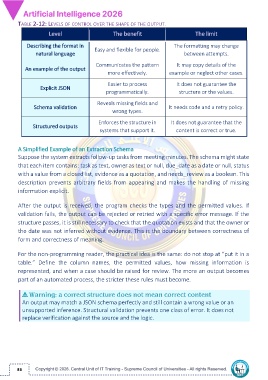
TABLE 2-12: LEVELS OF CONTROL OVER THE SHAPE OF THE OUTPUT

                       Level                       The benefit                          The limit

             Describing the format in                                         The formatting may change
                                           Easy and flexible for people.
                 natural language                                                  between attempts.

                                            Communicates the pattern            It may copy details of the
            An example of the output
                                                 more effectively.          example or neglect other cases.

                                                 Easier to process             It does not guarantee the
                   Explicit JSON
                                                programmatically.                structure or the values.

                                            Reveals missing fields and
                Schema validation                                           It needs code and a retry policy.
                                                   wrong types.

                                             Enforces the structure in       It does not guarantee that the
                Structured outputs
                                             systems that support it.          content is correct or true.


         A Simplified Example of an Extraction Schema

         Suppose the system extracts follow-up tasks from meeting minutes. The schema might state
         that each item contains: task as text, owner as text or null, due_date as a date or null, status
         with a value from a closed list, evidence as a quotation, and needs_review as a boolean. This

         description  prevents  arbitrary  fields  from  appearing  and  makes  the  handling  of  missing
         information explicit.

         After the output is received, the program checks the types and the permitted values. If
         validation fails, the output can be rejected or retried with a specific error message. If the

         structure passes, it is still necessary to check that the quotation exists and that the owner or
         the date was not inferred without evidence. This is the boundary between correctness of

         form and correctness of meaning.

         For the non-programming reader, the practical idea is the same: do not stop at “put it in a
         table.”  Define  the  column  names,  the  permitted  values,  how  missing  information  is
         represented, and when a case should be raised for review. The more an output becomes

         part of an automated process, the stricter these rules must become.

           ⚠ Warning: a correct structure does not mean correct content
           An output may match a JSON schema perfectly and still contain a wrong value or an
           unsupported inference. Structural validation prevents one class of error. It does not
           replace verification against the source and the logic.


         85

