


Page 82 - CyberSecurityEssentialsEnglish
P. 82
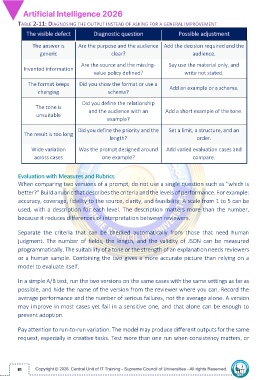
TABLE 2-11: DIAGNOSING THE OUTPUT INSTEAD OF ASKING FOR A GENERAL IMPROVEMENT

             The visible defect            Diagnostic question                  Possible adjustment

                The answer is       Are the purpose and the audience  Add the decision required and the
                   generic                         clear?                              audience.

                                     Are the source and the missing-        Say use the material only, and
            Invented information
                                           value policy defined?                   write not stated.

             The format keeps       Did you show the format or use a
                                                                            Add an example or a schema.
                  changing                       schema?

                                      Did you define the relationship
                 The tone is
                                        and the audience with an           Add a short example of the tone.
                 unsuitable
                                                 example?

                                    Did you define the priority and the     Set a limit, a structure, and an
            The result is too long
                                                  length?                                order.

               Wide variation       Was the prompt designed around         Add varied evaluation cases and
                across cases                  one example?                             compare.


         Evaluation with Measures and Rubrics
         When comparing two versions of a prompt, do not use a single question such as “which is
         better?” Build a rubric that describes the criteria and the levels of performance. For example:

         accuracy, coverage, fidelity to the source, clarity, and feasibility. A scale from 1 to 5 can be
         used, with a description for each level. The description matters more than the number,

         because it reduces differences of interpretation between reviewers.

         Separate  the  criteria  that  can  be  checked  automatically  from  those  that  need  human
         judgment.  The  number  of  fields,  the  length,  and  the  validity  of  JSON  can  be  measured
         programmatically. The suitability of a tone or the strength of an explanation needs reviewers

         or a human sample. Combining the two gives a more accurate picture than relying on a
         model to evaluate itself.

         In a simple A/B test, run the two versions on the same cases with the same settings as far as
         possible, and hide the name of the version from the reviewer where you can. Record the

         average performance and the number of serious failures, not the average alone. A version
         may improve in most cases yet fail in a sensitive one, and that alone can be enough to
         prevent adoption.


         Pay attention to run-to-run variation. The model may produce different outputs for the same

         request, especially in creative tasks. Test more than one run when consistency matters, or


         81

