


Page 394 - CyberSecurityEssentialsEnglish
P. 394
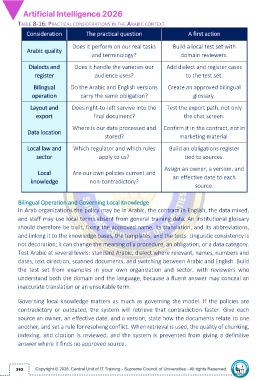
TABLE 8-16: PRACTICAL CONSIDERATIONS IN THE ARABIC CONTEXT

             Consideration             The practical question                        A first action

                                 Does it perform on our real tasks            Build a local test set with
             Arabic quality
                                          and terminology?                       domain reviewers.


              Dialects and        Does it handle the varieties our         Add dialect and register cases
                register                   audience uses?                           to the test set.

                Bilingual       Do the Arabic and English versions          Create an approved bilingual

               operation             carry the same obligation?                        glossary.

               Layout and        Does right-to-left survive into the       Test the export path, not only
                 export                    final document?                         the chat screen.


                                 Where is our data processed and  Confirm it in the contract, not in
             Data location
                                               stored?                           marketing material.

             Local law and       Which regulator and which rules            Build an obligations register

                 sector                      apply to us?                          tied to sources.

                                                                          Assign an owner, a version, and
                  Local          Are our own policies current and
                                                                              an effective date to each
               knowledge                 non-contradictory?
                                                                                        source.


         Bilingual Operation and Governing Local Knowledge

         In Arab organizations the policy may be in Arabic, the contract in English, the data mixed,
         and staff may use local terms absent from general training data. An institutional glossary
         should therefore be built, fixing the approved name, its translation, and its abbreviations,
         and linking it to the knowledge bases, the templates, and the tests. Linguistic consistency is

         not decoration; it can change the meaning of a procedure, an obligation, or a data category.
         Test Arabic at several levels: standard Arabic, dialect where relevant, names, numbers and

         dates, text direction, scanned documents, and switching between Arabic and English. Build
         the  test  set  from  examples  in  your  own  organization  and  sector,  with  reviewers  who
         understand both the domain and the language, because a fluent answer may conceal an

         inaccurate translation or an unsuitable term.

         Governing local knowledge matters as much as governing the model. If the policies are
         contradictory  or  outdated,  the  system  will  retrieve  that  contradiction  faster.  Give  each
         source an owner, an effective date, and a version, state how the documents relate to one

         another, and set a rule for resolving conflict. When retrieval is used, the quality of chunking,
         indexing,  and  citation is reviewed, and  the system is prevented from  giving  a definitive
         answer where it finds no approved source.


        393

