


Page 398 - CyberSecurityEssentialsEnglish
P. 398
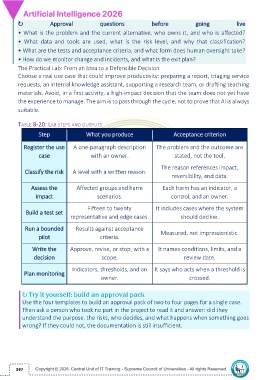
↻             Approval              questions              before              going             live
         • What is the problem and the current alternative, who owns it, and who is affected?

         •  What  data  and  tools  are  used,  what  is  the  risk  level,  and  why  that  classification?
         • What are the tests and acceptance criteria, and what form does human oversight take?

         • How do we monitor change and incidents, and what is the exit plan?
         The Practical Lab: From an Idea to a Defensible Decision
         Choose a real use case that could improve productivity: preparing a report, triaging service

         requests, an internal knowledge assistant, supporting a research team, or drafting teaching
         materials. Avoid, in a first activity, a high-impact decision that the team does not yet have
         the experience to manage. The aim is to pass through the cycle, not to prove that AI is always

         suitable.

         TABLE 8-20: LAB STEPS AND OUTPUTS
                  Step                 What you produce                       Acceptance criterion


            Register the use      A one-paragraph description         The problem and the outcome are
                  case                   with an owner.                        stated, not the tool.


                                                                         The reason references impact,
            Classify the risk    A level with a written reason.
                                                                             reversibility, and data.

               Assess the          Affected groups and harm              Each harm has an indicator, a

                 impact                     scenarios.                       control, and an owner.

                                        Fifteen to twenty             It includes cases where the system
            Build a test set
                                representative and edge cases.                   should decline.

            Run a bounded          Results against acceptance
                                                                        Measured, not impressionistic.
                  pilot                      criteria.

               Write the        Approve, revise, or stop, with a       It names conditions, limits, and a
                decision                      scope.                               review date.


                                 Indicators, thresholds, and an  It says who acts when a threshold is
            Plan monitoring
                                              owner.                                 crossed.


           ↻ Try it yourself: build an approval pack

           Use the four templates to build an approval pack of two to four pages for a single case.
           Then ask a person who took no part in the project to read it and answer: did they
           understand the purpose, the risks, who decides, and what happens when something goes
           wrong? If they could not, the documentation is still insufficient.


        397

