


Page 386 - CyberSecurityEssentialsEnglish
P. 386
redesign work so that human capability increases and so that the responsibility, the skills,
           and the relationships that give work its meaning remain.

         A job is made of tasks, and tasks differ in how far they can be automated. AI may shorten

         the  time  spent  on  initial  research,  coordination,  or  preparing  a  draft,  but  it  does  not
         automatically  hold  an  understanding  of  the  institutional  context,  it  does  not  bear  the

         consequences of a decision, and it does not build human trust in the same way. It is therefore
         more accurate to analyze a job into tasks than to announce that a whole profession will
         disappear or survive.

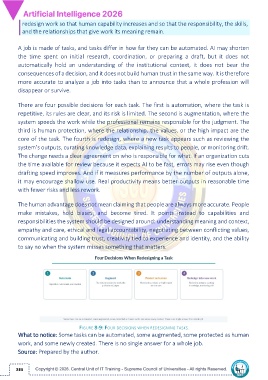
         There are four possible decisions for each task. The first is automation, where the task is

         repetitive, its rules are clear, and its risk is limited. The second is augmentation, where the
         system speeds the work while the professional remains responsible for the judgment. The
         third is human protection, where the relationship, the values, or the high impact are the

         core of the task. The fourth is redesign, where a new task appears such as reviewing the
         system’s outputs, curating knowledge data, explaining results to people, or monitoring drift.
         The change needs a clear agreement on who is responsible for what. If an organization cuts

         the time available for review because it expects AI to be fast, errors may rise even though
         drafting speed improves. And if it measures performance by the number of outputs alone,

         it may encourage shallow use. Real productivity means better outputs in reasonable time
         with fewer risks and less rework.

         The human advantage does not mean claiming that people are always more accurate. People
         make  mistakes,  hold  biases,  and  become  tired.  It  points  instead  to  capabilities  and
         responsibilities the system should be designed around: understanding meaning and context,

         empathy and care, ethical and legal accountability, negotiating between conflicting values,
         communicating and building trust, creativity tied to experience and identity, and the ability

         to say no when the system misses something that matters.


                                    FIGURE 8-9: FOUR DECISIONS WHEN REDESIGNING TASKS
         What to notice: Some tasks can be automated, some augmented, some protected as human
         work, and some newly created. There is no single answer for a whole job.

         Source: Prepared by the author.


        385

