


Page 384 - CyberSecurityEssentialsEnglish
P. 384
the context of use, and the people affected. Commission guidance makes clear that training
         should not be uniform for everyone, but built around the role, the risk, and the actual tool
         [8].


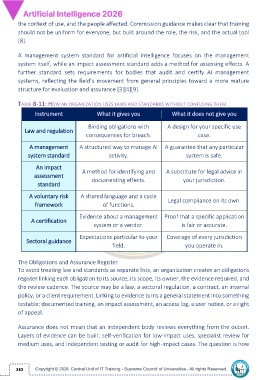
         A  management  system  standard  for  artificial  intelligence  focuses  on  the  management

         system itself, while an impact assessment standard adds a method for assessing effects. A
         further  standard  sets  requirements  for  bodies  that  audit  and  certify  AI  management

         systems, reflecting the field’s movement from general principles toward a more mature
         structure for evaluation and assurance [3][4][9].

         TABLE 8-11: HOW AN ORGANIZATION USES LAWS AND STANDARDS WITHOUT CONFUSING THEM

                Instrument                  What it gives you                What it does not give you

                                        Binding obligations with           A design for your specific use
            Law and regulation
                                       consequences for breach.                          case.

              A management          A structured way to manage AI  A guarantee that any particular
             system standard                     activity.                          system is safe.


                 An impact
                                      A method for identifying and         A substitute for legal advice in
                assessment
                                          documenting effects.                    your jurisdiction.
                  standard


              A voluntary risk       A shared language and a cycle
                                                                            Legal compliance on its own.
                 framework                     of functions.

                                    Evidence about a management  Proof that a specific application
               A certification
                                           system or a vendor.                    is fair or accurate.

                                    Expectations particular to your        Coverage of every jurisdiction
             Sectoral guidance
                                                   field.                          you operate in.


         The Obligations and Assurance Register
         To avoid treating law and standards as separate lists, an organization creates an obligations
         register linking each obligation to its source, its scope, its owner, the evidence required, and

         the review cadence. The source may be a law, a sectoral regulation, a contract, an internal
         policy, or a client requirement. Linking to evidence turns a general statement into something
         testable: documented training, an impact assessment, an access log, a user notice, or a right

         of appeal.

         Assurance does not mean that an independent body reviews everything from the outset.
         Layers of evidence can be built: self-verification for low-impact uses, specialist review for
         medium uses, and independent testing or audit for high-impact cases. The question is how


        383

