


Page 380 - CyberSecurityEssentialsEnglish
P. 380
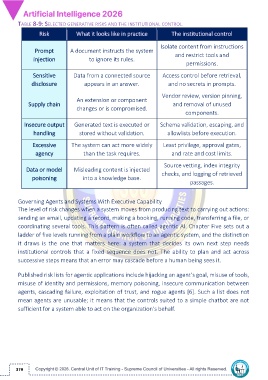
TABLE 8-9: SELECTED GENERATIVE RISKS AND THE INSTITUTIONAL CONTROL

                   Risk            What it looks like in practice            The institutional control

                                                                        Isolate content from instructions
                 Prompt         A document instructs the system
                                                                               and restrict tools and
                injection                to ignore its rules.
                                                                                    permissions.

                Sensitive         Data from a connected source           Access control before retrieval,
               disclosure             appears in an answer.                 and no secrets in prompts.


                                                                         Vendor review, version pinning,
                                   An extension or component
              Supply chain                                                    and removal of unused
                                   changes or is compromised.
                                                                                   components.


            Insecure output       Generated text is executed or         Schema validation, escaping, and
                handling            stored without validation.             allowlists before execution.

               Excessive         The system can act more widely          Least privilege, approval gates,

                 agency               than the task requires.                and rate and cost limits.

                                                                          Source vetting, index integrity
             Data or model        Misleading content is injected
                                                                         checks, and logging of retrieved
               poisoning              into a knowledge base.
                                                                                     passages.


         Governing Agents and Systems With Executive Capability
         The level of risk changes when a system moves from producing text to carrying out actions:

         sending an email, updating a record, making a booking, running code, transferring a file, or
         coordinating several tools. This pattern is often called agentic AI. Chapter Five sets out a
         ladder of five levels running from a plain workflow to an agentic system, and the distinction

         it  draws  is  the  one  that  matters  here:  a  system  that  decides  its  own  next  step  needs
         institutional controls that a fixed sequence does not. The ability  to plan and  act  across
         successive steps means that an error may cascade before a human being sees it.


         Published risk lists for agentic applications include hijacking an agent’s goal, misuse of tools,

         misuse of identity and permissions, memory poisoning, insecure communication between
         agents, cascading failure, exploitation of trust, and rogue agents [6]. Such a list does not
         mean agents are unusable; it means that the controls suited to a simple chatbot are not

         sufficient for a system able to act on the organization’s behalf.


        379

