


Page 347 - CyberSecurityEssentialsEnglish
P. 347
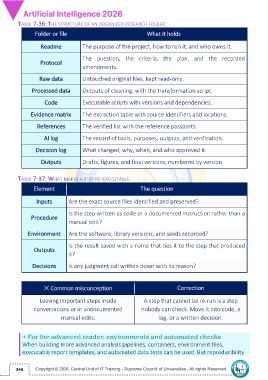
TABLE 7-36: THE STRUCTURE OF AN ORGANIZED RESEARCH FOLDER

                 Folder or file                                   What it holds

                   Readme             The purpose of the project, how to run it, and who owns it.

                                      The  question,  the  criteria,  the  plan,  and  the  recorded
                   Protocol
                                      amendments.

                   Raw data           Untouched original files, kept read-only.

               Processed data         Outputs of cleaning, with the transformation script.


                     Code             Executable scripts with versions and dependencies.

               Evidence matrix        The extraction table with source identifiers and locations.

                 References           The verified list with the reference passports.


                     AI log           The record of tools, purposes, outputs, and verification.

                 Decision log         What changed, why, when, and who approved it.

                   Outputs            Drafts, figures, and final versions, numbered by version.


         TABLE 7-37: WHAT MAKES A STEP RE-EXECUTABLE

                Element                                        The question

                 Inputs         Are the exact source files identified and preserved?

                                Is the step written as code or a documented instruction rather than a
               Procedure
                                manual edit?

             Environment        Are the software, library versions, and seeds recorded?

                                Is the result saved with a name that ties it to the step that produced
                Outputs
                                it?

               Decisions        Is any judgment call written down with its reason?


                     ✕ Common misconception                                     Correction

                   Leaving important steps inside                A step that cannot be re-run is a step

                conversations or in undocumented                nobody can check. Move it into code, a
                            manual edits.                               log, or a written decision.


           + For the advanced reader: environments and automated checks

           When building more advanced analysis pipelines, containers, environment files,
           executable report templates, and automated data tests can be used. But reproducibility


        346

