


Page 343 - CyberSecurityEssentialsEnglish
P. 343
address it. Avoid asking an author to run an entirely new study merely to broaden interest,
         and avoid imposing unnecessary citations.

         When receiving reviews, a tool can help you classify the comments and build a response
         table,  but it should not write  an  automatic defensive  reply. Read the comment, decide

         whether it is correct or the product of ambiguity in your text, and then state the change or
         the reason for not changing, with evidence. A response is not a victory; it is an improvement

         of the record.

         In  institutional  review  of  policies  or  reports,  the  same  logic  applies:  an  independent
         reviewer, a list of criteria, documented comments, clear responses, and no concealment of
         amendments. The presence of a tool does not remove the value of a human second pair of

         eyes, especially when the report affects people, a budget, or a reputation.

         The most serious problem in automated review is overconfidence. A tool may criticize the
         absence of an element that is in fact present, request a test unsuited to the data, or generate
         references  to  justify  a  comment.  Every  suggestion  needs  verification.  More  than  one

         perspective can be used, a methodological reviewer, a field reviewer, and a clarity reviewer,
         with the decision remaining with the researcher or the editor.

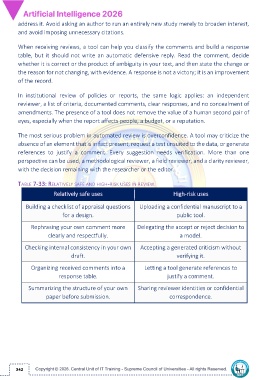
         TABLE 7-33: RELATIVELY SAFE AND HIGH-RISK USES IN REVIEW

                         Relatively safe uses                                 High-risk uses

            Building a checklist of appraisal questions        Uploading a confidential manuscript to a

                             for a design.                                      public tool.

               Rephrasing your own comment more               Delegating the accept or reject decision to
                      clearly and respectfully.                                  a model.


            Checking internal consistency in your own          Accepting a generated criticism without
                                 draft.                                         verifying it.

               Organizing received comments into a               Letting a tool generate references to

                           response table.                                 justify a comment.

              Summarizing the structure of your own           Sharing reviewer identities or confidential
                     paper before submission.                               correspondence.


        342

