


Page 322 - CyberSecurityEssentialsEnglish
P. 322
In  qualitative  research,  synthesis  may  involve  grouping  themes,  building  higher-order
         concepts, or comparing interpretations across settings. The analysis must stay close to the
         participants’ data, and we must note that translating or summarizing quotations with a tool

         may lose tone, context, or power relations. Coding is reviewed against the original text, and
         decisions that changed the themes are documented.


         An evidence map helps display what exists and where the gaps are, without claiming a causal

         answer. It may be a matrix or a diagram linking topics to designs, populations, and outcomes.
         It is useful for decision-makers and researchers in identifying where to focus, but it does not
         replace quality appraisal.

         Disciplined inference distinguishes three levels: what we found, what we believe explains it,

         and what we recommend. A recommendation does not follow automatically from an effect
         size;  it  depends  also  on  risks,  costs,  values,  equity,  and  feasibility.  Policy  briefs  must
         therefore make the move from evidence to option explicit.


         A tool can play the role of a methodological opponent: ask it to extract cases that contradict

         the main theme, propose an alternative explanation for each conclusion, and identify a
         sentence that goes beyond the evidence. But do not rely on its critique alone; it may invent
         objections or fail to notice a domain-specific constraint.


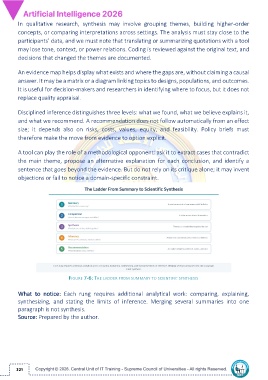
                                FIGURE 7-6: THE LADDER FROM SUMMARY TO SCIENTIFIC SYNTHESIS


         What  to  notice:  Each  rung  requires  additional  analytical  work:  comparing,  explaining,
         synthesizing,  and  stating  the  limits  of  inference.  Merging  several  summaries  into  one
         paragraph is not synthesis.
         Source: Prepared by the author.


        321

