


Page 259 - CyberSecurityEssentialsEnglish
P. 259
where am I going? How am I doing? And what is the next step? Reviews have found that the
         effect of feedback varies with its type, its timing, and its focus [8][9].

         Feedback is more useful when it focuses on the task, the process, or self-regulation, rather
         than  on  the  attributes  of  the  person.  Instead  of  “you  are  weak  at  analysis”,  say:  “the

         comparison names two differences but does not use a consistent criterion; reorganize the
         table so that the two options are compared on cost, impact, and time.” That comment is

         actionable and preserves the learner’s dignity.

         AI can offer first comments on a draft against a rubric, but it may be overconfident, apply
         the  criterion  inconsistently,  or  favor  a  particular  style  of  writing.  The  comments  must
         therefore  be  tested  against  reference  examples,  it  must  be  decided  whether  they  are

         advisory or count towards a grade, and the learner must be able to request an explanation
         or a human review.

         A good rubric describes performance criteria and levels of quality in observable language. It
         is not enough for the levels to be “excellent, good, weak”. It must state what makes the

         evidence complete, coherent, or accurate. A tool can propose the wording, but the teacher
         ensures that the criteria reflect the learning outcome and do not reward decoration or
         length.


         Assessment that supports learning provides an opportunity to try again. If a learner receives

         a  comment  after  the  task  has  ended  and  cannot  apply  it,  the  comment  becomes  an
         explanation of the grade. But if they revise part of the work, solve a new example, or write

         an improvement plan, the feedback becomes part of the learning itself.


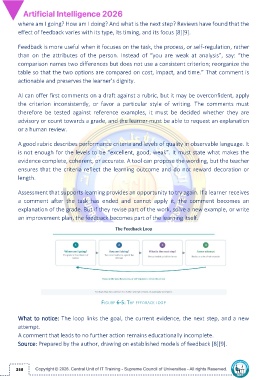
                                              FIGURE 6-5: THE FEEDBACK LOOP

         What to notice: The loop links the goal, the current evidence, the next step, and a new

         attempt.
         A comment that leads to no further action remains educationally incomplete.
         Source: Prepared by the author, drawing on established models of feedback [8][9].


        258

