


Page 176 - CyberSecurityEssentialsEnglish
P. 176
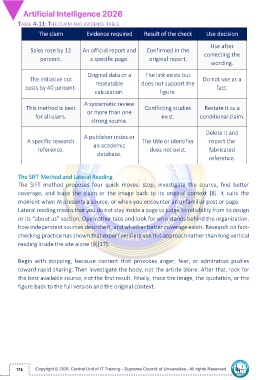
TABLE 4-11: THE CLAIM AND EVIDENCE TABLE

                  The claim            Evidence required         Result of the check         Use decision

                                                                                               Use after
               Sales rose by 12       An official report and      Confirmed in the
                                                                                            correcting the
                   percent.              a specific page.          original report.
                                                                                               wording.

                                        Original data or a        The link exists but
              The initiative cut                                                           Do not use as a
                                            repeatable          does not support the
            costs by 40 percent.                                                                 fact.
                                           calculation.                 figure.

                                      A systematic review
             This method is best                                 Conflicting studies        Restate it as a
                                        or more than one
                 for all users.                                          exist.           conditional claim.
                                          strong source.

                                                                                            Delete it and
                                      A publisher index or
             A specific research                                The title or identifier       report the
                                           an academic
                  reference.                                        does not exist.           fabricated
                                            database.
                                                                                              reference.


         The SIFT Method and Lateral Reading
         The  SIFT  method  proposes  four  quick  moves:  stop,  investigate  the  source,  find  better

         coverage,  and  trace  the  claim  or  the  image  back  to  its  original  context  [8].  It  suits  the
         moment when AI presents a source, or when you encounter an unfamiliar post or page.
         Lateral reading means that you do not stay inside a page to judge its reliability from its design

         or its “about us” section. Open other tabs and look for who stands behind the organization,
         how independent sources describe it, and whether better coverage exists. Research on fact-
         checking practice has shown that expert verifiers use this approach rather than long vertical

         reading inside the site alone [9][17].


         Begin  with  stopping,  because  content  that  provokes  anger,  fear,  or  admiration  pushes
         toward rapid sharing. Then investigate the body, not the article alone. After that, look for
         the best available source, not the first result. Finally, trace the image, the quotation, or the
         figure back to the full version and the original context.


        175

