


Page 124 - CyberSecurityEssentialsEnglish
P. 124
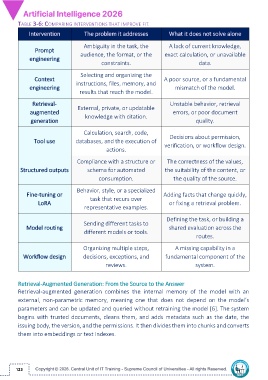
TABLE 3-6: COMPARING INTERVENTIONS THAT IMPROVE FIT

              Intervention            The problem it addresses              What it does not solve alone

                                      Ambiguity in the task, the            A lack of current knowledge,
                 Prompt
                                     audience, the format, or the         exact calculation, or unavailable
              engineering
                                              constraints.                               data.

                                     Selecting and organizing the
                Context                                                   A poor source, or a fundamental
                                   instructions, files, memory, and
              engineering                                                      mismatch of the model.
                                    results that reach the model.

               Retrieval-                                                    Unstable behavior, retrieval
                                    External, private, or updatable
              augmented                                                       errors, or poor document
                                       knowledge with citation.
               generation                                                               quality.

                                      Calculation, search, code,
                                                                            Decisions about permission,
                Tool use           databases, and the execution of
                                                                          verification, or workflow design.
                                                actions.

                                   Compliance with a structure or          The correctness of the values,
          Structured outputs            schema for automated              the suitability of the content, or

                                             consumption.                     the quality of the source.

                                   Behavior, style, or a specialized
             Fine-tuning or                                               Adding facts that change quickly,
                                         task that recurs over
                  LoRA                                                      or fixing a retrieval problem.
                                      representative examples.

                                                                           Defining the task, or building a
                                      Sending different tasks to
             Model routing                                                  shared evaluation across the
                                      different models or tools.
                                                                                        routes.

                                      Organizing multiple steps,               A missing capability in a
           Workflow design            decisions, exceptions, and          fundamental component of the

                                                reviews.                                system.


         Retrieval-Augmented Generation: From the Source to the Answer
         Retrieval-augmented  generation  combines  the  internal  memory  of  the  model  with  an
         external,  non-parametric  memory,  meaning  one  that  does  not  depend  on  the  model’s

         parameters and can be updated and queried without retraining the model [6]. The system
         begins  with trusted  documents,  cleans them,  and  adds metadata such  as  the date, the
         issuing body, the version, and the permissions. It then divides them into chunks and converts

         them into embeddings or text indexes.


        123

