


Page 8 - CyberSecurityEssentialsEnglish
P. 8
Introduction

             In the contemporary digital era, cybersecurity has become one of the most critical pillars for ensuring business
       continuity and safeguarding data and digital assets. The world today is witnessing an unprecedented expansion in
       internet usage, the widespread proliferation of smart devices, and increasing interconnectedness among systems. This
       rapid digital transformation has significantly heightened the exposure of information to cyber threats, which range
       from hacking and fraud to digital extortion.
            Cybersecurity technologies play a fundamental role in protecting sensitive data, whether related to individuals,
       institutions, governments, or states, regardless of the nature of such data or the severity of the consequences resulting
       from its disclosure or breach. With the growing prevalence of global cyber threats such as ransomware and targeted
       attacks, cybersecurity is no longer a luxury but an essential necessity for ensuring a secure and sustainable digital
       future.

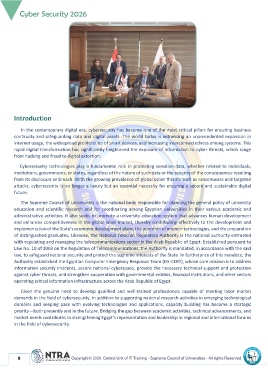
             The Supreme Council of Universities is the national body responsible for planning the general policy of university
       education  and  scientific  research  and  for  coordinating  among  Egyptian  universities  in  their  various  academic and
       administrative activities. It also seeks to promote a university education system that advances human development
       and enhances competitiveness in the global labor market, thereby contributing effectively to the development and
       implementation of the State’s economic development plans, the adoption of modern technologies, and the preparation
       of distinguished graduates, Likewise, the National Telecom Regulatory Authority is the national authority entrusted
       with regulating and managing the telecommunications sector in the Arab Republic of Egypt. Established pursuant to
       Law No. 10 of 2003 on the Regulation of Telecommunications, the Authority is mandated, in accordance with the said
       law, to safeguard national security and protect the supreme interests of the State. In furtherance of this mandate, the
       Authority established the Egyptian Computer Emergency Response Team (EG-CERT), whose core mission is to address
       information security incidents, secure national cyberspace, provide the necessary technical support and protection
       against cyber threats, and strengthen cooperation with governmental entities, financial institutions, and other sectors
       operating critical information infrastructure across the Arab Republic of Egypt.

             Given  the  genuine  need  to  develop  qualified  and  well-trained  professionals  capable  of  meeting  labor  market
       demands in the field of cybersecurity, in addition to supporting national research activities in emerging technological
       domains  and  keeping  pace  with  evolving  technologies  and  applications,  capacity  building  has  become  a  strategic
       priority—both presently and in the future. Bridging the gap between academic activities, technical advancements, and
       market needs contributes to strengthening Egypt’s representation and leadership in regional and international forums
       in the field of cybersecurity.


          6

