


Page 18 - CyberSecurityEssentialsEnglish
P. 18
Cyberattacks
       Cyberattacks refer to stealing information belonging to individuals, companies, and governments, obtaining
       unauthorized access to computer networks, with the aim of disrupting services provided by organizations
       and businesses, and provoking public turmoil. However, hackers use various methods and techniques to
       perform such attacks; like:

       In phishing attacks,

       large amounts of fraudulent emails are sent to unsuspicious victims, masked as coming from a reliable source.
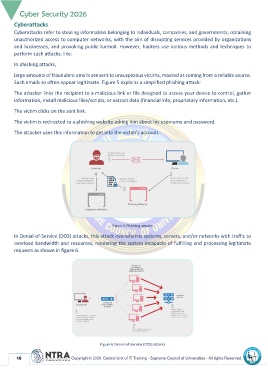
       Such emails so often appear legitimate. Figure 5 explains a simplified phishing attack:

       The attacker links the recipient to a malicious link or file designed to access your device to control, gather
       information, install malicious files/scripts, or extract data (financial info, proprietary information, etc.).

       The victim clicks on the sent link.

       The victim is redirected to a phishing website asking him about his username and password.

       The attacker uses this information to get into the victim's account.


                                                   Figure 5 Phishing attacks

       In Denial-of-Service (DOS) attacks, this attack overwhelms systems, servers, and/or networks with traffic to
       overload bandwidth and resources, rendering the system incapable of fulfilling and processing legitimate
       requests as shown in figure 6.


                                             Figure 6 Denial-of-Service (DOS) attacks

          16

