


Page 369 - CyberSecurityEssentialsEnglish
P. 369
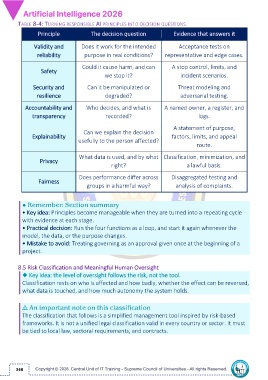
TABLE 8-4: TURNING RESPONSIBLE AI PRINCIPLES INTO DECISION QUESTIONS

                  Principle              The decision question                Evidence that answers it

                Validity and         Does it work for the intended              Acceptance tests on
                  reliability         purpose in real conditions?         representative and edge cases.


                                      Could it cause harm, and can           A stop control, limits, and
                   Safety
                                                we stop it?                      incident scenarios.

                Security and            Can it be manipulated or                Threat modeling and

                 resilience                     degraded?                        adversarial testing.

            Accountability and         Who decides, and what is           A named owner, a register, and
               transparency                     recorded?                                logs.


                                                                              A statement of purpose,
                                      Can we explain the decision
               Explainability                                                factors, limits, and appeal
                                    usefully to the person affected?
                                                                                        route.


                                    What data is used, and by what  Classification, minimization, and
                   Privacy
                                                  right?                            a lawful basis.

                                    Does performance differ across           Disaggregated testing and
                  Fairness
                                        groups in a harmful way?               analysis of complaints.


           ● Remember: Section summary
           • Key idea: Principles become manageable when they are turned into a repeating cycle
           with evidence at each stage.
           • Practical decision: Run the four functions as a loop, and start it again whenever the
           model, the data, or the purpose changes.

           • Mistake to avoid: Treating governing as an approval given once at the beginning of a
           project.

         8.5 Risk Classification and Meaningful Human Oversight
           ◆ Key idea: the level of oversight follows the risk, not the tool.

           Classification rests on who is affected and how badly, whether the effect can be reversed,
           what data is touched, and how much autonomy the system holds.

           ⚠ An important note on this classification

           The classification that follows is a simplified management tool inspired by risk-based
           frameworks. It is not a unified legal classification valid in every country or sector. It must
           be tied to local law, sectoral requirements, and contracts.


        368

