


Page 367 - CyberSecurityEssentialsEnglish
P. 367
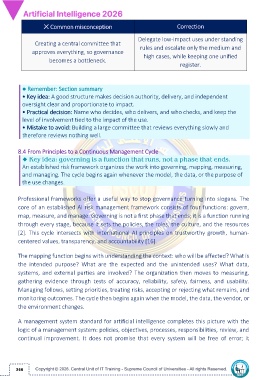
✕ Common misconception                                      Correction

                                                              Delegate low-impact uses under standing
                 Creating a central committee that
                                                               rules and escalate only the medium and
               approves everything, so governance
                                                                 high cases, while keeping one unified
                       becomes a bottleneck.
                                                                                 register.


           ● Remember: Section summary
           • Key idea: A good structure makes decision authority, delivery, and independent
           oversight clear and proportionate to impact.
           • Practical decision: Name who decides, who delivers, and who checks, and keep the
           level of involvement tied to the impact of the use.
           • Mistake to avoid: Building a large committee that reviews everything slowly and

           therefore reviews nothing well.


         8.4 From Principles to a Continuous Management Cycle
           ◆ Key idea: governing is a function that runs, not a phase that ends.
           An established risk framework organizes the work into governing, mapping, measuring,

           and managing. The cycle begins again whenever the model, the data, or the purpose of
           the use changes.

         Professional frameworks offer a useful way to stop governance turning into slogans. The

         core of an established AI risk management framework consists of four functions: govern,
         map, measure, and manage. Governing is not a first phase that ends; it is a function running
         through every stage, because it sets the policies, the roles, the culture, and the resources

         [2]. This cycle intersects with international AI principles on trustworthy growth, human-
         centered values, transparency, and accountability [16].

         The mapping function begins with understanding the context: who will be affected? What is
         the  intended  purpose?  What  are  the  expected  and  the  unintended  uses?  What  data,

         systems, and  external parties are  involved? The organization then  moves to measuring,
         gathering  evidence  through  tests  of  accuracy,  reliability,  safety,  fairness,  and  usability.

         Managing follows, setting priorities, treating risks, accepting or rejecting what remains, and
         monitoring outcomes. The cycle then begins again when the model, the data, the vendor, or
         the environment changes.

         A management system standard for artificial intelligence completes this picture with the
         logic of a management system: policies, objectives, processes, responsibilities, review, and

         continual  improvement.  It  does  not  promise  that  every  system  will  be  free  of  error;  it


        366

